Showing posts with label 2014 Releases. Show all posts

November 17, 2015

Oliver Sparrow's Dark Sun, Bright Moon - Guest Post


Dark Sun, Bright Moon.
The book is set a thousand years ago in Peru. It reflects the strange views that the isolated Quechua people had formed during their ten thousand years of isolation. I myself first encountered this outlook in 1980, when Peru was a rough country engaged in the early stages of a brutal civil war.

I met my first shaman in Oxapampa, a remote town hanging in mist over the jungle proper. It had been founded by German emigres a hundred years earlier, and red faced blond men held donkeys in the main square, bargaining in accented Spanish.

Even getting there was a major exercise. In 1980, barely any of the principal roads were asphalted, and none of the lesser track. After you have ground your way up from the desert coast to 15,700 feet at the Ticlio pass, therefore, you wander through open, sere landscape that is dotted with llamas and alpacas. A sudden drop takes you to the pretty Tarma valley with its fields of gladioli and arums. On my first visit, this was still a red-tiled village with a single-track road that, a few miles later, fell down the walls of the vast cañon that opened to the tropical Chanchamayo valley. Fragrant with coffee and mangos, enshrouded in red dust, enormous trucks confronted you on this road and necessitated reversing for long distances to let them pass. The river was a little thread below, the road between a rock wall and a sheer fall At night, festooned with Christmas tree lights and covered with tinsel, these sudden apparitions could give way to nobody, even if they were minded to do so.

In twelve hours, therefore, you had gone from frigid desert to alpine extremes and then, in perhaps three of those hours, dropped down into the humid tropics. Clothing changed three times, and both customs and accents more times than that. Seagulls and pelicans are replaced by macaws and parrots. Chanchamayo was then an armed camp, as groups struggled to control the coffee trade, and it was a relief to climb into the Oxapampa valley. This was and remains a place of jungle dwellers and dripping, orchid-filled cloud forest. That ascent took a further six hours on disastrously terrible roads, but today all of this is demystified by tarmac and satnav.

The then-military government had imposed strict controls on vehicle imports, As a result, the company had only a thirty year old Land Rover which, on arriving in a coffee cooperative short of Oxoapampa, shuddered, grunted and passed its mortal bounds. The cooperative was celebrating a Saint’s day and everyone was mostly naked and sweaty drunk, gathering in a ring around the vehicle with their machetes just kissing the ground. The only light came from a bonfire, the houses were palm thatch and wood and any thought of a telephone would have been an anachronism.

Years earlier, I had damaged my back in another set of great mountains, and the gruelling journey had worsened this. I needed a pole just to get out of the car. We all stood and stared at each other until the head of the cooperative came forward, offered us a drink and suggested the services of the curandera, the healer. This was how I first met Esmeralda.

His Spanish was not good and I understood this to mean the village mechanic. I was therefore surprised by an elderly woman with sharp eyes who, without a word, she started pulling at my clothing. I have to say that I thought that this was the local mad woman, and was working out how to solve an awkward situation when the headman stopped me, saying that she, this person, was the curandera. She quickly had me shirtless and with my pants around my ankles, prodding at my back. Still without speaking, she grunted and turned away into the dark. “Esperate ahi”, wait here, said the headman, so I did, more or less naked in front of an audience of thirty rowdy drunks. Eventually, she returned with a pot of sweet-smelling paste. After she has sat me on a coffee sack and put my head between my knees she kneaded this into my back. This seemed to signify acceptance – or anyway the end of the fun - and the crowd dispersed, drinks were thrust on us and by one means or another, the pain faded away as well.

The next day, watched by men cradling hangovers, we identified the problem as being a dead fuel pump. There was no prospect of replacing this. However, Land Rovers have their spare wheel mounted in front, and removing this gives access to the engine. A plastic pipe came off the air horn to give us a fuel feed line, and a funnel bought from the cooperative provided a way to drip fuel into it. My minder Archie was to drive, whilst I was to sit on the bonnet and drip petrol into the funnel.

Before we left, Esmeralda let it be known that she wanted to travel to Lima with us, and so it was that we set out on a journey of three patient days. I learned quickly how perform as a human carburettor, dripping the fuel and clearing dust out of the ball-of-wool filer, I froze at Ticlio, and was happy to get into the cabin as we freewheeled down the face of the Andes to the first workshop we found on the outskirts of Lima.

Esmeralda vanished in the crowd without adding to the few word that she has spoken throughout. She had my address, however, and she made contact through the medium of dolls made from tied scraps of cloth and left on the doorstep overnight.

One evening, just as I was planning to return and complete the business that had had been aborted by the death of the Land River, she turned up in person. This began a friendship that took me into the strange arenas that Dark Sun, Bright Moon explores: the parallel continua that create our little world, the role of the shaman, the yachaq', to belief in a propitiation of the apus that guard and manage individual communities, to the saqras who may manifest themselves to favoured individuals.

Later, I learned that hers was a thin, distorted version of the original rich worldview. Five hundred years of repression had all but extinguished anything but a folk version of what had been a high metaphysic. Despite this, the essence of this view – of the individual as an expression of a community, of the danger to the community from disharmony amongst individuals – remains a vital element in today’s Andean communities, wound into Catholicism through syncretic beliefs. The local apu is now called San Pedro (St Peter) but they still go up the mountain to dance for him and feed him beer, or sacrifice a guinea pig or, for serious matters, a llama. Dark Sun, Bright Moon is an attempt to reconstruct this very different way of seeing the world. I hope that readers think that it succeeds. You can see feedback of their views at www.DarkSunBrightMoon.com

About the book
Dark Sun, Bright Moon, by Oliver Sparrow, was published in July 2014 and is available for sale on Amazon in both paperback and ebook.

Dark Sun, Bright Moon describes people isolated in the Andes, without the least notion of outsiders. They evolve an understanding of the universe that is complementary to our own but a great deal wider. The book explores events of a thousand years ago, events which fit with what we know of the region's history,” says Sparrow.

In the Andes of a thousand years ago, the Huari empire is sick. Its communities are being eaten from within by a plague, a contagion that is not of the body but of something far deeper, a plague that has taken their collective spirit. Rooting out this parasite is a task that is laid upon Q’ilyasisa, a young woman from an obscure little village on the forgotten borders of the Huari empire.

This impossible mission is imposed on her by a vast mind, a sentience that has ambitions to shape all human life. Her response to this entails confrontations on sacrificial pyramids, long journeys through the Amazonian jungle and the establishment of not just one but two new empires. Her legacy shapes future Andean civilization for the next four hundred years, until the arrival of the Spanish.

Dark Sun, Bright Moon takes the reader on a fascinating adventure that includes human sacrifice, communities eaten from within, a vast mind blazing under the mud of Lake Titicaca, and the rise and fall of empires cruel and kind.


About the Author
Oliver Sparrow was born in the Bahamas, raised in Africa and educated at Oxford to post-doctorate level, as a biologist with a strong line in computer science. He spent the majority of his working life with Shell, the oil company, which took him into the Peruvian jungle for the first time. He was a director at the Royal Institute for International Affairs, Chatham House for five years. He has started numerous companies, one of them in Peru, which mines for gold. This organisation funded a program of photographing the more accessible parts of Peru, and the results can be seen at http://www.all-peru.info. Oliver knows modern Peru very well, and has visited all of the physical sites that are described in his book Dark Sun, Bright Moon.

To learn more, go to http://www.darksunbrightmoon.com/

Goodreads 

September 25, 2015

Spotlight on Donald Michael Platt's Bodo, The Apostate


Bodo, the Apostate
by Donald Michael Platt

Publication Date: September 29, 2014
Raven’s Wing Books
Formats: eBook, Paperback
Genre: Historical Fiction


“… in the meantime, a credible report caused all ecclesiastics of the Catholic Church to lament and weep.” Prudentius of Troyes, Annales Bertiniani, anno 839

On Ascension Day May 22, 838, Bishop Bodo, chaplain, confessor, and favorite of both his kin, Emperor Louis the Pious, son of Charlemagne, and Empress Judith, caused the greatest scandal of the Carolingian Empire and the 9th century Roman Church.

Bodo, the novel, dramatizes the causes, motivations, and aftermath of Bodo’s astonishing cause célèbre that took place during an age of superstitions, a confused Roman Church, heterodoxies, lingering paganism, broken oaths, rebellions, and dissolution of the Carolingian Empire.


PRAISE
“In a masterfully controlled narrative, Platt builds up to this amazing moment, taking readers first through Bodo’s childhood, upbringing, and rise to power at the heart of the 9th century Carolingian Empire, whose kings, princes, prelates and ordinary people Platt captures with a pitch-perfect blend of research and dramatization. By the time the story winds its way to Bodo’s momentous decision, I, too, felt like everything in the world was on the line. A fantastic, thought-provoking novel; very enthusiastically recommended.” – Historical Novel Society (Editor’s Choice Pick)


ABOUT THE AUTHOR
Author of four other novels, ROCAMORA, HOUSE OF ROCAMORA, A GATHERING OF VULTURES, and CLOSE TO THE SUN, Donald Michael Platt was born and raised in San Francisco. Donald graduated from Lowell High School and received his B.A. in History from the University of California at Berkeley. After two years in the Army, Donald attended graduate school at San Jose State where he won a batch of literary awards in the annual SENATOR PHELAN LITERARY CONTEST.

Donald moved to southern California to begin his professional writing career. He sold to the TV series, MR. NOVAK, ghosted for health food guru, Dan Dale Alexander, and wrote for and with diverse producers, among them as Harry Joe Brown, Sig Schlager, Albert J. Cohen, Al Ruddy plus Paul Stader Sr, Hollywood stuntman and stunt/2nd unit director. While in Hollywood, Donald taught Creative Writing and Advanced Placement European History at Fairfax High School where he was Social Studies Department Chairman.

After living in Florianópolis, Brazil, setting of his horror novel A GATHERING OF VULTURES, pub. 2007 & 2011, he moved to Florida where he wrote as a with: VITAMIN ENRICHED, pub.1999, for Carl DeSantis, founder of Rexall Sundown Vitamins; and THE COUPLE’S DISEASE, Finding a Cure for Your Lost “Love” Life, pub. 2002, for Lawrence S. Hakim, MD, FACS, Head of Sexual Dysfunction Unit at the Cleveland Clinic.

Currently, Donald resides in Winter Haven, Florida where he is polishing a dark novel and preparing to write a sequel to CLOSE TO THE SUN.

For more information please visit Donald Michael Platt’s website. You can also connect with him on Facebook and Twitter.


Tour Schedule: http://hfvirtualbooktours.com/bodotheapostateblogtour2/
Hashtags: #BodotheApostateBlogTour #HistoricalFiction
Twitter Tags: @hfvbt @donroc

July 30, 2015

Book Blast - Hilary Rhodes' The Lion and the Rose & The Outlander King

03_Book One_William Rising

The Lion and the Rose (Book One: William Rising)

Publication Date: June 18, 2014
eBook; 338 Pages | ASIN: B00L4K5GKE
 Genre: Historical Fiction

  Add to GR Button  

The Lion and the Rose, Part One: William Rising is the first book in an epic historical saga from debut author Hilary Rhodes. Extensively researched and compellingly told, it introduces us to the passionate drama and violent upheaval of eleventh-century Europe. The world as we know it, and the English language, would have been vastly different were it not for the driving ambition of one man: William the Conqueror. But conquerors are made, not born, and William was made in fire and blood. How does a boy become a man, surviving a tumultuous and terrifying childhood? And how does that man become a legend? William Rising plunges us into this world of danger and betrayal, of choosing sides and dying for absolutes. It follows the creation of a conqueror, as he grows up abandoned, learns to fight at an early age for anything he hopes to keep, and is sculpted into a remorseless, far-sighted, ruthlessly efficient soldier and statesman. From his origins as an orphaned, penniless bastard boy, to his personal and political trials by fire, to the climactic battle with his rebellious barons where he finally comes of age, the young duke increasingly establishes himself as a force to be reckoned with. But as the shadowy intrigues of English politics, and the all-consuming question of an heir for a childless king, begin to draw him into their web, it may just be that William of Normandy has a destiny far greater than even he has ever dreamed.

AMAZON | BARNES & NOBLE | ITUNES | KOBO

03_Book Two_The Gathering Storm

The Lion and the Rose (Book Two: The Gathering Storm)

Publication Date: September 29, 2014
eBook; 294 Pages | ASIN: B00O2E30GG
Genre: Historical Fiction

  Add to GR Button  

The Lion and the Rose: William Rising introduced us to the young William, Duke of Normandy, and his treacherous and terrible childhood, beset by battles, betrayals, and heartbreak, as he fought his own barons to survive and claim his birthright. The Gathering Storm plunges us even deeper into the violent upheaval and passionate drama of his unfolding story. Now twenty-two, William has won his most pivotal battle and taken control of his inheritance, but impossible struggles loom as he fights to put Normandy back together -- and very few of his enemies are actually defeated. Furthermore, across the Channel, the question of an heir for a childless king begins to loom large, and the ruthless and scheming Godwin, Earl of Wessex, will stop at nothing to claim it for his family. Written with the same meticulous historical research and flair by debut author Hilary Rhodes, The Gathering Storm raises the stakes to the utmost level, and a crown and a kingdom hang in the balance. In these pages, lords rise and fall, England and Normandy are drawn into a perilous collision course, bishops, barons, dukes, queens, and earls play a dangerous game of power and glory, and those who are not strong enough are trampled underfoot. The crows circle and the banners are raised, and the last Saxon king and the greatest Norman duke are destined to face each other in a battle that will change the course of history.

AMAZON | BARNES & NOBLE | ITUNES | KOBO

04_The Outlander King

The Outlander King (The Aetheling's Bride, Book One)

Publication Date: June 1, 2015
eBook; 476 Pages | ASIN: B00XM9QJ1K
 Genre: Historical Fiction

  Add to GR Button  

The story of The Lion and the Rose and the Norman Conquest continues in this spellbinding new historical fiction series from author Hilary Rhodes, pulling back the curtain on the lives of two remarkable women connected across centuries: Aislinn, a seventeen-year-old English girl caught up in the advancing army of the “outlander king,” the man who will become known to history as William the Conqueror. Thrust into the center of the new Norman court and a dizzying web of political intrigue and plotting princes, she must choose her alliances carefully in a game of thrones where the stakes are unimaginably high. Embroiled in rebellions and betrayals, Aislinn learns the price of loyalty, struggles to find her home, and save those she loves – and, perhaps, her own soul as well. Almost nine hundred years later in 1987, Selma Murray, an American graduate student at Oxford University, is researching the mysterious “Aethelinga” manuscript, as Aislinn’s chronicle has come to be known. Trying to work out the riddles of someone else’s past is a way for Selma to dodge her own troubling ghosts – yet the two are becoming inextricably intertwined. She must face her own demons, answer Aislinn’s questions, and find forgiveness – for herself and others – in this epically scaled but intimately examined, extensively researched look at the creation of history, the universality of humanity, and the many faces it has worn no matter the century: loss, grief, guilt, redemption, and love.

AMAZON | BARNES & NOBLE | ITUNES | KOBO

02_Author Hilary Rhodes

ABOUT THE AUTHOR

Hilary Rhodes is a scholar, author, blogger, and all-around geek who fell in love with medieval England while spending a year abroad at Oxford University. She holds a B.A. and M.A. in history, and is currently preparing for doctoral studies at the University of Leeds, fulfilling a years-long dream to return to the UK. In what little spare time she has, she enjoys reading, blogging about her favorite TV shows, movies, and books, music, and traveling. For more information please visit Hilary Rhodes' blog.

BOOK BLAST SCHEDULE

Monday, July 27
Kinx's Book Nook
Tuesday, July 28
Book Nerd
What Is That Book About
Wednesday, July 29
The Never-Ending Book
To Read, Or Not to Read
Thursday, July 30
Books and Benches
Historical Fiction Connection
Friday, July 31
The Lit Bitch
Queen of All She Reads
Sunday, August 2
Genre Queen
Monday, August 3
The Maiden's Court
Tuesday, August 4
Room With Books
Passages to the Past
Wednesday, August 5
100 Pages a Day
The True Book Addict
Thursday, August 6
A Book Geek
Boom Baby Reviews
Friday, August 7
CelticLady's Reviews
Let Them Read Books

05_HR_Book Blast Banner_FINAL

June 25, 2015

Spotlight on Mary F. Burn's Isaac and Ishmael {Giveaway}


Please join Mary F. Burns as she tours the blogospere with HF Virtual Book Tours for Isaac and Ishmael: A Novel of Genesis from June 8-26.

Publication Date: November 15, 2014
Sand Hill Press
Formats: eBook, Paperback
Genre: Historical Fiction/Biblical


Isaac and Ishmael attempts to bring to human scale the legends and mythic dimensions of Abraham and Sarah, their sons Isaac and Ishmael, and Isaac and Rebecca’s twin sons Esau and Jacob. Readers will experience the struggles, competition, betrayals and loves of these brothers, fathers and sons caught up in the overarching tension between time and eternity, a place where a new God is coming into being—Yahweh, the uncanny, irascible, mischievous, bargaining God who participated in the life of a new people and compelled them to a new way of being human.

The stormy relationship of Isaac and Ishmael has long passed into a tradition which looks to Isaac as the father of the Jewish people, and Ishmael as the father of the Arab people, particularly in Egypt. Similarly, while Jacob carries on his father’s heritage, becoming the father of the Twelve Tribes of Israel, his twin brother Esau, the red-haired archer who sold his birthright for a bowl of lentil soup, is traditionally said to have departed for the North, and populated what would later become Rome. Isaac and Ishmael explores the thorny, complex yet delicate relations between these brothers and fathers, providing a more human understanding of the differences that arise between individuals and peoples, even now as the ancient tensions in the Middle East continue to flare up in modern confrontations and war. Ever present in the story are the strong, subtle and often ambitious women of Biblical legend: Sarah, Rebecca, Rachel and Leah.

Official Book Trailer


About the Author
Mary F. Burns is the author of ISAAC AND ISHMAEL, published by Sand Hill Review Press in November 2014. Other historical fiction includes THE SPOILS OF AVALON and PORTRAITS OF AN ARTIST (Sand Hill Review Press, February 2014, 2013), both books featuring the celebrated portrait painter, John Singer Sargent and his best friend, writer Violet Paget (aka Vernon Lee). Mary is a member of and book reviewer for the Historical Novel Society and a former member of the HNS Conference board of directors. Her debut historical novel J-THE WOMAN WHO WROTE THE BIBLE was published in July 2010 by O-Books (John Hunt Publishers, UK). She has also written two cozy-village mysteries in a series titled The West Portal Mysteries (The Lucky Dog Lottery and The Tarot Card Murders). She will be part of two panels at the upcoming North American Historical Novel Society Conference in June in Denver, one on The Historical Mystery and the other on Art and Artists in Historical Fiction.

Ms. Burns was born in Chicago, Illinois and attended Northern Illinois University in DeKalb, where she earned both Bachelors and Masters degrees in English, along with a high school teaching certificate. She relocated to San Francisco in 1976 where she now lives with her husband Stuart in the West Portal neighborhood.

Ms. Burns may be contacted by email at maryfburns@att.net. For more information please visit Mary Burns’s website at www.maryfburns.com. You can also connect with Mary on FacebookTwitter, andGoodreads, or read her blog posts at:


Tour Schedule
Hashtags: #IsaacandIshmaelBlogTour #HistoricalFiction
Twitter Tags: @hfvbt @jwriter9

GIVEAWAY 
One copy - print or eBook - Open to US only for Print, Internationally for eBook. To enter, please comment below with your favorite historical story from the bible. Last day to enter: Thursday, July 9 at 11:59pm CST.

Rules– Must be 18 or older to enter.
– Only one entry per household.
– All giveaway entrants agree to be honest and not cheat the systems; any suspect of fraud is decided upon by blog/site owner and the sponsor, and entrants may be disqualified at our discretion.

June 12, 2015

Charlotte Brentwood's The Vagabond Vicar - Guest Post and {Giveaway}


A Matter of Life and Death: Women in the Regency Period

As a modern woman in this frantic world of ours, it’s easy to romanticise the past and wish we were one of the regency ladies we love to read about. We imagine a glittering life of balls and horse-drawn carriages, grand estates and seaside excursions.

Those carriage rides could be very bumpy and uncomfortable, with distances between towns taking many hours. And the horses… let’s just say they don’t clean up after themselves. Even the people would have been quite, er, fragrant. But the economic realities of genteel Regency women are perhaps the greatest reason for us to be grateful we live in modern times.

It was extremely rare for a woman to inherit her family’s fortune. Even a generous dowry would go to her husband on marriage. A gentlewoman had no way of providing for herself. If she was not fortunate enough to marry, she would need to rely on her family for sustenance. On the death of her parents, a brother would need to agree to take her in. If circumstances didn’t work out, she would quickly drop down the social strata, with a governess being the best position she could hope for, and at worst she would need to go to London and find some manual labour to undertake. In extreme cases securing a husband could be a matter of life and death.

Once married, our gentlewoman wasn’t assured a happily-ever-after. Many marriages were purely an economic arrangement without much love or fidelity. Childbirth carried a high risk of complications or death, and of course with no contraception this would be endured many times. As a wife she was her husband’s property and he was in charge of her fate including where she lived and what she could spend. Although many women could do charity work to contribute to society, long years of “morning visits” and embroidery must have gotten quite tedious for intelligent minds.

It’s because of these circumstances that I love finding my heroines men who will not only secure their material happiness, but also love and contentment. It is and was a rare thing, and thankfully we can escape into stories where, despite the inevitable challenges, love prevails.

About the book
William Brook is an idealistic young cleric, desperate to escape dreary England for a mission adventure in exotic lands. It's his worst nightmare come true when he is posted to a parish in a small backwater village, populated with small-minded people and husband-hunting mamas. He’s determined not to form any ties and to escape the country as an independent single man.

A free spirit, Cecilia Grant is perfectly content to remain in her family home in Amberley village - when she's not wandering the countryside at all hours painting. Marriage options are few, but that won't stop her mother from engineering a match with one of the ruling family's sons. Cecilia attempts to win the man, but what is it about the new vicar and his brooding ways that is so appealing? Could he be the only one who has ever really understood her, and can she discover what he is running away from?

As William struggles not to fall in love with the lady's intoxicating beauty and mysterious eccentricity, he finds himself drawn into the lives of the villagers, despite their best efforts to alienate the newcomer. When he makes it clear he's not sticking around, Cecilia strives to restrain her blossoming feelings for him. Just when it seems love may triumph, dark secrets are revealed in Amberley and a scandal from William’s past may see the end of not only his career, but his chance at finding an everlasting love.

The Vagabond Vicar is an unashamedly romantic historical novel you'll fall in love with. If you love Jane Austen and Georgette Heyer, can't get enough of Downton Abbey or Cranford, or just prefer old-fashioned boy-meets-girl stories, try reading Charlotte Brentwood.

Sensuality level: sweet (only kissing)
Please note, although there is some mention of religious subject matter due to the hero's occupation, this is not an "inspirational" novel.

Photo from Goodreads

About the author
Charlotte developed serious crushes on a series of men from age fifteen: Darcy, Knightley, Wentworth and Brandon. A bookworm and scribbler for as long as she can remember, Charlotte always dreamed of sharing her stories with the world.

Earning a degree in communication studies, she was seduced by the emerging digital world and has since worked with the web and in marketing. She lives in beautiful Auckland, New Zealand.

When she's not toiling at her day job, writing or procrastinating on the Internet, Charlotte can be found snuggling with her cat Sophie, warbling at the piano, sipping a hot chocolate or enjoying the great outdoors.


Giveaway
Follow the instructions on the GLEAM form to enter for an eBook copy of The Vagabond Vicar. Open internationally!

The Vagabond Vicar Giveaway

May 13, 2015

Alison McMahan's The Saffron Crocus - Guest Post and {Giveaway}

PORTRAIT OF A WOMAN COMPOSER
Guest blog by Alison McMahan


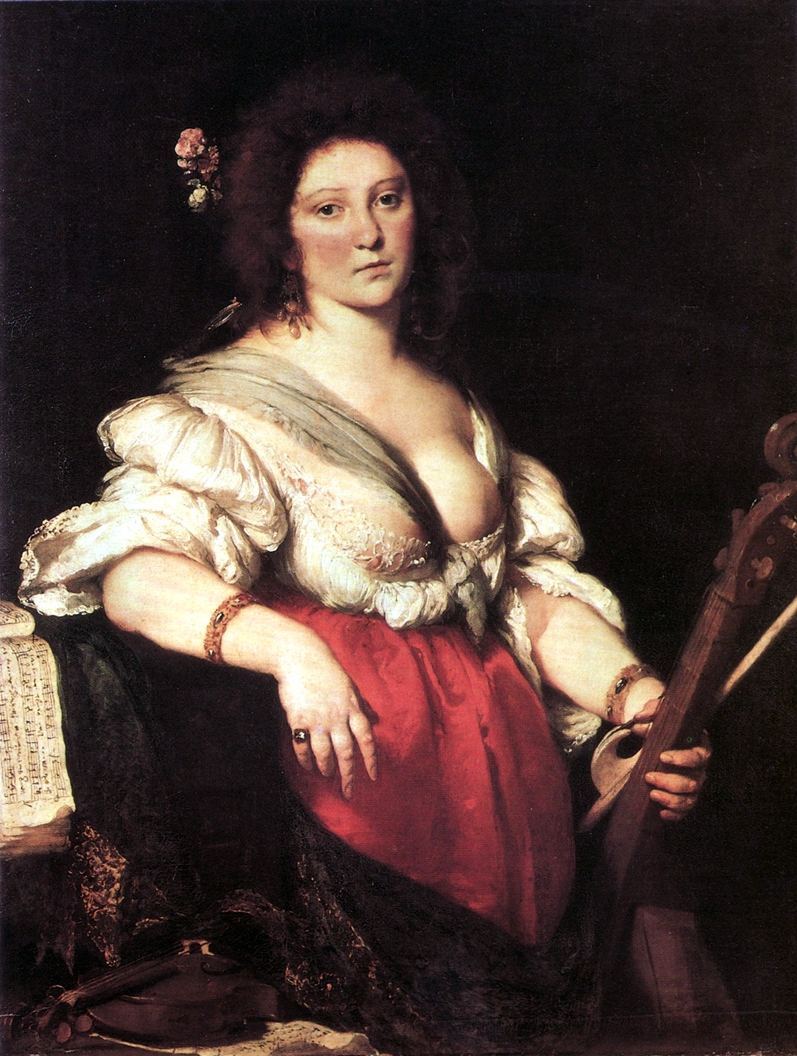
The paintings of Bernardo Strozzi greatly inspired me when it came to creating the characters in my book, The Saffron Crocus. Strozzi was a painter who fled Genoa because he no longer wanted to live as a Capuchin monk. He ended up in Venice where he produced many portraits, including one of Claudio Monteverdi, until his death in 1644.

In addition to his portraits he painted many allegorical paintings, images of saints, and scenes of daily life. He painted pictures of St. Cecilia several times, images such as this one:


St. Cecilia's had several traditional features: the transported expression, the musical instrument, the modest dress among them. 

Then Strozzi painted the image of "Woman with a Viola da Gamba." 

The painting has some of the elements that match it to a St. Cecilia: the musical instrument, the pose of a young woman visible to the waist. But there all resemblance to a picture of saint ends. This young woman is not transported, she looks at the viewer directly, with a worldly and somewhat bored gaze. She is not modest at all; in fact, her cleavage is so low that one breast is completely bared. 

The bared breast and the fact that there is a violin in the image, along with her viola da gamba, and the music is for a duet suggests that she is waiting for a partner to come and "make music" with her. In other words, that she is a courtesan. 

I referred to this image in The Saffron Crocus, and the heroine's discovery of it marks a key turning point in her understanding of the world. At the time I wrote the book I accepted the traditional interpretation of the painting, that the pose and the décolletage indicated that the sitter was a courtesan. Since then I've learned a few things which are much more interesting than the traditional interpretation.

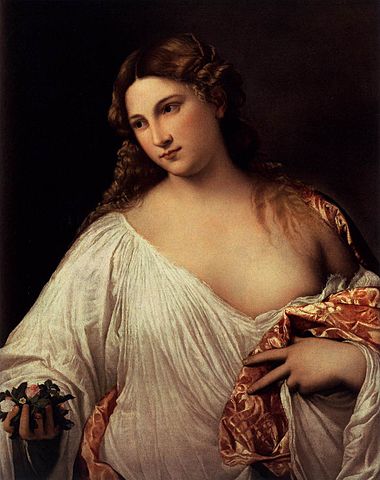
For example, some have argued that the portrait is an allegorical image, of Flora, similar to Titian's:


Courtesans in Venice did bare their breasts, as a way of marketing their goods, and tinted their nipples red. Or they stood on their roofs, bleaching their hair to achieve a blond color, wearing nothing but a shimmery shift that also revealed their breasts to any passerby. 

But it's hard to say that the bare breast in this image indicates the woman is a courtesan. Strozzi used bare-breasted women in many images, usually allegorical ones, such as his allegory of the arts:


Scholars David Rosand and Ellen Rosand have argued that the picture of the viola da gamba player picture is actually a portrait of Barbara Strozzi (no relation to Bernardo). They have various reasons for this attribution, mainly, that events we know about her life match the depiction in the image. Specifically, they refer to the fact that Barbara Strozzi was the "mistress of ceremonies" of the Accademia degli Unisoni, a salon for philosophical and artistic discussion organized by her adoptive (her perhaps natural) father, Giulio Strozzi. The Rosands mention a particular event that might have led to the pose and costume in the portrait in which Barbara sang and handed out flowers as prizes to the one who wrote the most impressive argument on whether tears or song was the most potent weapon in love. 

As I read about this attribution I became eager to know more about Barbara Strozzi. Not whether she was a courtesan (there is evidence that she partnered with one man most of her life, as she had three children with him) but as a musician. 

She wasn't the first musician to have her music published. That honor goes to Maddalena Cassulana whose first work, a collection of four madrigals, was published in Florence in 1566. But Strozzi published voluminously, more than any other composer of her time. She is credited with creating the cantata. And she did all this without the patronage of a noble or the church. She spent her life trying to find such patronage and did not succeed. 

She did have her father's support, though. At least one scholar claims Giulio Strozzi created the Accademia degli Unisoni to encourage her work. Though her association with the Unisoni is also what led to outsiders claiming she had sold her virtue. 

It seems sad to me that what most people might know about Strozzi is these allegations that she was a courtesan. That bared breast is all we see when we look at that image. I encourage my readers to listen to her music instead. Here's a lovely performance of her aria "Che si può fare":


About the book
Publication Date: December 13, 2014
Black Opal Books
eBook; 306p
Genre: Young Adult/Historical Mystery/Romance

Add to GR Button

Winner of the 2014 Rosemary Award for Best Historical for Young Adults.
Venice, 1643. Isabella, fifteen, longs to sing in Monteverdi’s Choir, but only boys (and castrati) can do that. Her singing teacher, Margherita, introduces her to a new wonder: opera! Then Isabella finds Margherita murdered. Now people keep trying to kill Margherita’s handsome rogue of a son, Rafaele.

Was Margherita killed so someone could steal her saffron business? Or was it a disgruntled lover, as Margherita—unbeknownst to Isabella—was one of Venice’s wealthiest courtesans?

Or will Isabella and Rafaele find the answer deep in Margherita’s past, buried in the Jewish Ghetto?

Isabella has to solve the mystery of the Saffron Crocus before Rafaele hangs for a murder he didn’t commit, though she fears the truth will drive her and the man she loves irrevocably apart.

Excerpt

Who knew a singing career would be this much trouble?

“Rafaele!” She flew into the garret. “Piero, it was so wonderful, wait until I tell you!”

The stool next to the bed was knocked over. The tray with the genepy bottle was on the floor, one of the cups broken. The fat candle that had been burning next to Rafaele’s bed had been flung to the other side of the room.. Canvases were strewn all over the floor, some of them slashed, and many of Master Strozzi’s jars of paint elements were broken.

Did Piero and Rafaele have a fight? She quickly suppressed the thought. Who would get into a fight with a man who was already injured?

Something else must have happened.

She walked across the garret. “Piero? Rafaele, are you here?”

Rafaele was not in the bed. The sheets and blankets she had piled on top of him were strewn everywher. Blood-stained sheets spilled over the edge of the pallet. There was a pile of clothes on the floor.

She walked around to get a closer look.

Not clothes. It was Piero. Face down, one arm stretched out before him, as if in supplication.

A puddle of blood under him.

Dead.

Praise for The Saffron Crocus
“I adored this beautifully written, passionate book. The Saffron Crocus is a glittering, thrilling opera of a novel that plucked my heartstrings and kept me reading at fever pitch. Brava, Alison McMahan! Encore!” -Nancy Holder, New York Times Bestselling Author of the Wicked Saga

Buy the eBook


About the Author
Alison McMahan chased footage for her documentaries through jungles in Honduras and Cambodia, favelas in Brazil and racetracks in the U.S. She brings the same sense of adventure to her award-winning books of historical mystery and romantic adventure for teens and adults. Her latest publication is The Saffron Crocus, a historical mystery for young. Murder, Mystery & Music in 17th Century Venice.

She loves hearing from readers!

Author Links


Tour Schedule: http://hfvirtualbooktours.com/thesaffroncrocusblogtourandbookblast/
Hashtags: #TheSaffronCrocusBookBlast #TheSaffronCrocusBlogTour #YA #Historical #Venice
Twitter Tags: @hfvbt @AlisonMcMahan

Giveaway
Enter to win a paperback copy of The Saffron Crocus, open to US residents only.

Rules
– Must be 18 or older to enter.
– Giveaway is open to US residents only..
– Only one entry per household.
– All giveaway entrants agree to be honest and not cheat the systems; any suspect of fraud is decided upon by blog/site owner and the sponsor, and entrants may be disqualified at our discretion.


The Saffron Crocus Giveaway

May 11, 2015

Spotlight on Christian Kachel's Spoils of Olympus: By the Sword


322 BC. What happens when the most powerful man in the world unexpectedly dies without naming a successor? Many great HF novels have been written about ancient Greece and, in particular, Alexander the Great, yet few works are set in the little known age following his demise and preceding the eventual Roman dominance of his empire. My historical novel blends epic military engagements, involving historical figures, with a unique intrigue involving fictitious secret societies and human intelligence tradecraft, to tell a powerful story of loyalty and bloodshed during this uncharted literary era.

As a boy, Andrikos watched as Alexander's army marched through his homeland of Greek Ionia after defeating King Darius III at the Granicus River on their way to the total conquest of the Persian Empire. Soon he will be embroiled in their world, forced to flee his old life due to an unintentional crime. Thrust into the royal army, Andrikos struggles to cope with brutal training that prepares him for the coming wars of succession as Alexander's surviving generals seek to divide and conquer the spoils of Olympus.

But Andrikos is not destined to be a nameless soldier; by chance he is chosen for a clandestine mission - and is immersed in a world of intrigue, violence and brotherhood. The path that lies ahead requires Andrikos to shed his immaturity and take on the responsibilities and emotions of a man beyond his years as he struggles to save Alexander's legacy from those who wish to usurp it.

Received three 5 star reviews from the Reader's Favorite Book Review and Award Contest:

"Christian Kachel has done his homework, researching the facts, details, and time lines for his historical fiction novel, The Spoils of Olympus: By the Sword. The character development and scenes are skillfully well written and amazingly intriguing. A reader will find themselves enthralled with each scene, page, and word of this epic tale. I thoroughly enjoyed this book. As an avid historical fiction reader, I am anxiously awaiting news of a second book release, and recommend this book to any reader interested in historical fiction, or just history and fiction in general." 
--Michelle Robertson from Reader's Favorite

"Mr. Kachel has woven together an expertly researched tale. Although lengthy, I was held riveted to every page, wondering what would become of Andrikos. This is truly a tale of rags to riches. Andrikos never expects to be given certain opportunities, but he does redeem himself from the shame he left behind in Ilandra. I could tell that, despite his harsh methods, Vettias thought of Andrikos as a sort of surrogate son and perhaps someone to continue his legacy in the King’s Hand. Add in the spunky prostitute Mara as a recruited spy and Kachel gives us a cast of characters that will not soon be forgotten. I look forward to reading other books by this author and avidly await the sequel of By the Sword." 
--Heather Osborne from Reader's Favorite

"Apart from revealing parts of history, the book also offers readers good suspense and intrigue. The character development of Andrikos from that of a boy to a man is done effortlessly. The author has researched well and has shared with readers that time in history which many of us are not so aware of. The author has given a lot of attention to detail and any student of history will enjoy this. The story and its setting have a good pace and will keep readers glued to the book. I liked the author's style of writing which is descriptive and detailed and makes the plot and the scenes very clear. Historical stories always catch my interest and this one with history, intrigue anthe journey of Andrikos is highly entertaining." 
--Mamta Madhaven from Reader's Favorite


About the author
Christian is a Long Island, NY native and current resident of Northern Virginia. While attending the University of Maryland- College Park, the events of September 11, 2001 inspired him to join the U.S. Army ROTC program and volunteer for three tours of duty in Iraq and Afghanistan upon commissioning into the Army Reserves in 2003. He holds three Master's degrees and works in the defense industry.

May 05, 2015

Charles Gibson's Taking the Cross - Guest Post


The Roots of the Inquisition

When Pope Innocent III called for the Crusade against heresy in March, 1208, he could not have known the full force of what he was unleashing. Known as the Albigensian Crusade, this endeavor, proclaimed because of the death of a papal legate in the Languedoc region of France, led to the deaths of tens of thousands over the next twenty years, devastating one of the most wealthy and free regions of Europe in the early 13th century. 

It also led to the Inquisition. Contrary to what you might think, the Inquisition started in France in the 13th century, not centuries later in Spain.

My historical novel, Taking the Cross, is set during the opening summer of the Albigensian Crusade, in 1209. The main male character, Andreas, is lead knight to Raimon Roger Trencavel, the Viscount of Carcassonne, Albi, and Beziers. The Viscount, a historical figure, was the main target of the Crusade. Thus Andreas ends up fighting against a Crusade.

Charles Gibson in front of the Tower of the Heretics in Carcassonne, France.
Heretics were hanged inside from the crossbeams of the tower in the 13th century.

Yet the efforts of the Catholic Church to purge the Languedoc of heresy were not warlike at their inception. In the year 1203, Dominic of Osma appeared before Pope Innocent III asking to make pilgrimage to the Holy Land in order to proselytize Muslims. Innocent, more vexed over the spread of heresies throughout Christendom, and in the Languedoc in particular, had a different idea. His charge to the idealistic canon from Spain was that Dominic make journey to Southern France and preach to the Albigensian sect, known also as the Cathars.

The word Cathar comes from the Greek root word katharsos, which means “pure”. It is also the root of the English word catharsis, which means purification or cleansing. The Cathars believed in purifying themselves from this evil world. They took that quite literally and believed that all matter had been created by the devil and was therefore evil, including the wafers and wine of the Eucharist (or communion), and even one’s own body. They believed that Christ came in spirit form only and thus was neither born of a virgin nor executed upon a cross.

Such decidedly unorthodox views put them at odds with the Roman Catholic Church. Since it was believed in Medieval times that the survival of society depended on that society being likeminded, dissent could not be tolerated. This was true not only in religious belief but also in the practice of one’s beliefs.

This is seen very clearly in the case of the other group targeted by the Albigensian Crusade, the Waldensians. The followers of Peter Waldo from the city of Lyon, France, were targeted primarily because they wanted to practice their faith in a way deemed unacceptable by Rome. They wished to preach in public in the common tongue and also to translate the Bible into the common tongue so that all could have access to the Scriptures. What little preaching there was at this time was in Latin and nearly all Bibles were in Latin as well. The message from Rome was clear: You must not only believe as we do, but act as we do.

At first the beliefs of the Waldensians were little different than those of other Catholics, but over time they came to reject the use of relics, of infant baptism, of purgatory, and the supremacy of the pope. After repeated persecutions they eventually came to refer to the pope as “the whore of Babylon”.

Dominic was a countercultural figure in that he took a vow of poverty in contrast to the Catholic hierarchy of the day, who paraded around in opulence. Dominic traveled around the Languedoc barefoot and in the coarse tunic of a mendicant, humbly seeking alms wherever he went. In so doing he had more success than others, but that success was still limited. After five years journeying back and forth across the Languedoc, he had gleaned at most a few dozen converts.

Rome grew impatient with the lack of progress. The murder of papal legate Pierre de Castelnau in January, 1208, provided the perfect pretense to launch the Crusade that began in 1209. Dominic died in 1221, but the Crusade lasted until 1229. Dominic’s humble, peaceful means of proselytizing in the Languedoc died with him.

In 1231 the Inquisition began and was administered, ironically, by those in the Dominican order, the followers of the peaceful man who became known as St. Dominic. The tactics of the Inquisition became a basis for the modern police state. For example, those who concealed or gave aid to heretics in any way were forced to wear a yellow cross sewn into their garments. It gives reminder of the yellow Star of David that Jews were forced by the Nazis to wear during World War II.

Yet the Albigensian Crusade and the Inquisition that followed became a motivating force for religious freedom that eventually led to the Reformation. The Waldensians persisted through decades and centuries of terrible persecution and voted to join the Reformation in the year 1532.

But in July, 1209, as Taking the Cross opens and Viscount Raimon Roger Trencavel rides to meet the leaders of the Crusade to seek peace, all of that is an unknown.

About the book
In the Middle Ages not all Crusades were fought in the Holy Land.

A two-pronged threat to the Catholic Church was growing within Christendom itself and Pope Innocent III called for the Crusade against heresy to eliminate both the Albigenses and Valdenses, two movements that did not adhere to Church orthodoxy.

Andreas, a knight who longs to go on Crusade to the Holy Land, finds himself fighting against one in his French homeland. While Andreas wages war for the lives and religious freedom of his people, a battle rages within his soul.

Eva, a young woman of a new religious order, the Beguines, discovers a secret message within a letter about the death of her father in the Holy Land. As she learns more of her father, she is forced to confront the profound and perilous spiritual inheritance he has bequeathed to her. A legacy for which she must fight.

Hearing of the feats of Andreas, Eva senses her inheritance may lead her to him.

They both face an evil that threatens to consume them.

Filled with battles of the flesh and the spirit, Taking the Cross reveals a passionate aspect of Medieval times where some fought ardently for the freedom of others.

Buy the book

Visit the author

May 01, 2015

Chris Karlsen's Silk - Guest Post and {Giveaway}


A Muse With A Historical Bent

My father taught history. The politics, culture, and people of different periods was a common topic in our house. When I decided to do what I'd secretly wanted to try for many years, write, my long quiet muse went in search of people and events to build a world around.

Not all periods and places interest me while others have a strong draw for me. I write a Knights in Time series where a part of the story is set in medieval England and occasionally France. The battle of Poitiers, a great English victory fought in 1356, is the common denominator for those characters. My latest release, Silk, a suspense/thriller, is set in Victorian England, London in particular.

I chose Victorian London for a couple of reasons. So much changed over that time period, developments in industry and the expansion of the British Empire are two examples. The period conjures up both romantic images perfect for Christmas cards and menacing images of dark allies and people living hard lives. You could turn a corner and run into a polished carriage pulled by a handsome team of horses, or, you could turn a corner and run into Jack the Ripper. I thought it the most atmospheric of cities for my killer and detective to challenge each other.

Another reason I chose this time period (1888) was for my protagonist's personal history and quality of character. Several years ago, I had the occasion to visit the South Wales Borderers regimental museum. I was interested in the Zulu wars of 1879 and in particular two battles fought by that regiment: Isandhlwana and Rorke's Drift. Eleven Victoria Crosses, the equivalent of our Medal of Honor, were awarded to the men who fought at Rorke's Drift. After speaking at great length with the volunteers at the museum who gave me a private tour, I knew if I ever wrote a book, one day I'd use a veteran of this battle as the protagonist.

In Silk, Detective Inspector Rudyard Bloodstone was ill with a serious fever when the hospital station at Rorke's Drift was attacked by thousands of Zulu warriors. He managed to rise and fight after saving the lives of several men unable to walk on their own. As a result, he was awarded a Victoria Cross for "Extreme valour in the face of the enemy." Rudyard (Ruddy) keeps the medal and the queen's declaration in his sock drawer. He doesn't consider himself a hero. To him, he was just a soldier doing what was necessary in battle.

I treat settings like characters. They are living, breathing things. They evoke emotions the way the men and women in the story do. They can be beautiful and make you want to stay in that moment and place. Or, they can frighten as cold fog wraps around the human characters and the dark holds danger. In the Knights in Time books, I loved recreating medieval England without the iconic trappings so familiar with today: Big Ben, double-decker buses, black cabs, and tourists gathered around Buckingham Palace. In Silk, I loved showing London through the eyes of the different classes. The multi—facets of the city. One oddity I discovered in my research was an "entertainment" enjoyed by the middle class. There's scene in Silk that takes place in an asylum. I learned for a time asylums made a profit by letting so called normal folk view the lunatics (a common term used at the time) for a penny a tour.

I try to recreate the place and time by walking through it mentally. Every sidewalk my protagonist goes down, every room he or she enters I note the details along with them. Since I can't time travel in reality, I can travel through time on the page.  

About the book       
Genre: Thriller
Author: Chris Karlsen
Website: www.chriskarlsen.com
Publisher: Books to Go Now
Purchase on Amazon

London-Fall, 1888

The city is in a panic as Jack the Ripper continues his murderous spree. While the Whitechapel police struggle to find him, Detective Inspector Rudyard Bloodstone and his partner are working feverishly to find their own serial killer. The British Museum's beautiful gardens have become a killing ground for young women strangled as they stroll through.

Their investigation has them brushing up against Viscount Everhard, a powerful member of the House of Lords, and a friend to Queen Victoria. When the circumstantial evidence points to him as a suspect, Rudyard must deal with the political blowback, and knows if they are going to go after the viscount, they'd better be right and have proof.

As the body count grows and the public clamor for the detectives to do more, inter-department rivalries complicate the already difficult case.


About the author
Chris is a Chicago native. Her family moved to Los Angeles when she was in her late teens where she later studied at UCLA. She graduated with a Business Degree. Her father was a history professor and her mother a voracious reader. She grew up with a love of history and books.

Her parents were also passionate about traveling and passed their passion onto Chris. Once bitten with the travel bug, Chris spent most of her adult life visiting the places she'd read about and that fascinated her. She's had the good fortune to travel Europe extensively, the Near East, and North Africa, in addition to most of the United States.

After college, Chris spent the next twenty-five years in law enforcement with two agencies. Harboring a strong desire to write since her teens, upon retiring from police work, Chris decided to pursue her writing career. She currently writes three different series. Her historical romance series is called, Knights in Time. Her romantic thriller series is Dangerous Waters, and he latest book, Silk, is book one in her mystery/suspense series, The Bloodstone series.

She currently lives in the Pacific Northwest with her husband and five wild and crazy rescue dogs.

Website / Facebook / Pinterest / Trailer
Giveaway
Enter to win a Silk prize pack (via the Gleam form below) as follows:
One winner will be awarded:
a copy (print or kindle) of Silk
a swag bag
a $10 Amazon gift card
a Kindle copy of Knights in Time (the author's boxed set of historical romances)


* Giveaway is open internationally.
* Giveaway ends at 11:59pm on May 8th.
* You must be 18 or older to enter.
* Only one entry per household.
* All giveaway entrants agree to be honest and not cheat the system; suspicions of fraud will be decided upon by blog/site owner and the sponsor. Disqualified entrants are decided at our discretion.
* Winners will be chosen via GLEAM on or around May 9th and notified via email. Winners have 48 hours to claim prize or new winner is chosen.
* Please email Michelle @ hfconnection@yahoo.com with any questions.

Silk

April 27, 2015

Roy T. Humphreys' Patrick's Journey - Guest Post


Patrick’s Journey is an historical fiction novel that is based on the real life history of my great grandfather (6 times removed). I first heard about his story at a family reunion many years ago and was captivated by the dramatic changes he experienced during his life’s journey (hence the title).

This was a story just waiting to be told, one of those where fact can seem stranger than fiction. However, I was constantly wondering about what his emotional journey must have been like. Nobody could have experienced the quantum shifts in circumstances that he did without having an equivalent "journey" of emotions. There had already been a number of historical articles published about him and so I decided I would deviate from the traditional approach and publish something that encompassed his emotional journey as well. Historical fiction was the obvious answer and so on retirement I embarked on a project that was to last the best part of eighteen months.

I soon found there was ample incidental history published about the times in which he lived. For example, there are numerous documents covering the United Irishmen and their struggle for independence. While Patrick's conviction papers refer to a civil matter (theft) there was an endorsement on one court document describing him as an "Irish Rebel". It wasn't hard to conjure circumstances that interwove a United Irishmen connection to his arrest and trial and tie that back to our family folklore which insists his punishment was a British Military "get square" for a dispute involving the family cow.

Similarly, there is considerable information published about the convict ship Boddington on which he was transported to Australia. In some ways Patrick was a lucky man. The Boddington was one of the first ships to adopt new hygiene and humanitarian measures designed to curb the appalling death rate amongst convicts being transported to the penal colony of New South Wales. There is significant mention of an attempted mutiny on the Boddington. However, while some papers name the would be mutineers, other publications claim the voyage was incident free. Mutiny or not, the prospect was too tempting for this author not to include the concept in the story and tie it in to Patrick's change of fortune following the serving of his sentence.

Many of the characters in the story are based on real people who lived their lives in Patrick's world. Others, such are the prime villain of the story, are purely figments of my imagination but hopefully they add entertainment without detracting from the historical content of the tale. There is an epilogue at the end of the book which provides details of the true history behind the story and of the characters which appear in it.

My hope is to entertain readers while at the same time keep the memory of my ancestor alive.

About the book
Patrick Rourke is a 17 year old Irishman in the year of 1790. Like many young men he is patriotic, adventurous and headstrong. He also feels assured of a bright future with his sweetheart Catherine. Patrick’s world comes crashing down around him when he becomes a pawn in the political aspirations of the United Irishmen under Wolfe Tone. He finds himself in prison sentenced to transportation to the penal colony of New South Wales and begins a downward spiral into rage and depression.

Patrick’s saviour comes in the form of Father Michael O’Court, the chaplain of the prison ship Boddington. Over time Patrick is guided out of his depression and is able to accept the vastly different directions that his life’s journey has taken. He also finds an unlikely mentor in one Preston Balfour, a British Army officer who was originally his target for assassination, but who ultimately provides him with the means of restoring his life in a new land. 

Patrick’s life is complete when tragic circumstances eventually lead to him being reunited with Catherine for a new life in a new land. He comes to realise that the most important journey we travel is not measured in miles but by our changes within. 

Patrick’s Journey is a work of fiction, but is based on the real life history of the author’s great (6 times removed) grandfather. 

Authors Note: 
Patrick’s Journey is a work of fiction and should only be viewed as such. However, it’s inspiration comes from the history of my great-grandfather (six times removed) about who we know the following: 

Patrick Humphreys was born in Wicklow County, Ireland in 1774. He was tried in 1791 in Dublin, found guilty of stealing and sentenced to 7yrs transportation to Australia. 

Family folklore maintains that Patrick was arrested on a “trumped-up” charge as a result of a clash between him and the local British Redcoats over a dispute involving the family cow. 

Prior to his arrest Patrick was “keeping company” with Catherine Mooney but their teenage romance was torn apart when he was sent overseas. Catherine eventually married another local lad, Terrence McMahon who took a position as a convict ship guard and ended up travelling to Australia with Catherine in 1800. Here they were reunited with Patrick who had completed his sentence and joined the NSW Corps. Terrence tragically drowned in Sydney harbour in 1801. Patrick and Catherine were married in Sydney on 28th February 1802 and lived long and fruitful lives raising a large family and establishing significant land holdings at Watsons Bay and Kincumber.

Click on image to view a larger version

Positive review at Historical Novel Society
Buy the book on Amazon


About the author
Roy Humphreys is retired (from paid work) and lives with wife Denise and daughter Rachael in the southern suburbs of Sydney, NSW, Australia.

His primary focus is now his family (four children, 8 grandchildren). He also finds time for running (cross country in the Royal National Park area), fishing and, sometimes, writing.

Patrick's Journey is based on the real life story of his great grandfather, 6 generations back, that he heard about at a family reunion many years ago. It was a story that he felt needed telling, but never had the time until retirement came in 2012.

April 08, 2015

David Blixt's The Prince's Doom - Guest Post

Verona Revisited

In writing The Prince’s Doom, the highlight was my return to Verona last year. The trip was arranged for the release of the Italian edition of The Master Of Verona, the first book in the series, and marked my fourth time in the city in the last 20 years. The first and third times I was there for pure tourism, staying for less than a day. But the second time was a heavy research trip, as was this latest one.

I could go on and on about having access I’d never been granted before (I got to sit in Cangrande’s chair!). I could talk about the places I’d never heard of, that became huge pieces of the novel (Santa Maria in Stelle!). But there was one event that bookended the two research trips perfectly. So it starts, as all my good stories do, with my wife.

My wife and I eloped in 2002, taking all the money we would have spent on a big wedding and spending it on the honeymoon instead. Which meant we were in Europe for over three months, exploring, making friends, and doing research. Eight days of that time was spent in Verona, as guests of the city. I had made a friend in the Ministry of Culture, and among the many wonderful people she connected me with, one was the descendent of Dante, still living on the vineyard bought in 1353 by Dante’s son Pietro (who just happened to be the lead character of the novel I was writing).

That first visit was memorable, to say the least, and my wife wrote an account of it here. (Do read it, it’s hilarious) (http://themasterofverona.typepad.com/the_master_of_verona/2012/06/guest-post-jan-blixt-and-coffee-with-the-count.html). He showed us the marriage carriage that was used when the family linked itself to the Serego clan, another famous Veronese family. We saw the family crest inlaid in the floor and over the mantle, beside framed photos of the Count's daughters. 


This is one of the things I like best about Verona. Everything is still in use. From the Arena, where they hold operas and concerts, to Cangrande's palace, which is not only the city hall but also houses the apartment of the chief of police, to a lovely condo Jan and I toured, with famous 19th century paintings the size of half a basketball court on the walls. They maintain the old, but with the new. Nothing is kept out of use, but rather worked seamlessly into daily life. 


So that was then. This time, 12 years later, it was filmmaker Anna Lerario, a new friend, who put me back in contact with the Count. We called ahead, and then Anna drove us out to the Count's abode in the country. Valpolicella is much more built up than I remember, and indeed when we spoke, the Count lamented the overdevelopment that's been happening. He's very much a Lord Grantham type, but instead of clinging to tradition, his vineyard has partnered with MASI wines, gaining him a huge distribution for his products. He sees the building that's been happening as speculative, and ruining the land upon which they make their living. 

Ever an elegant man, we sat down with him in the dining area of La Foresteria. I presented him with copies of all the Verona books - I'd sent one when MoV was first published, but it felt wonderful to hand him a copy in Italian as well. Then he, Jan, Anna, and I sat and talked.

The very best part was just letting the conversation wander. Before, I had only been interested in the 14th century history of the land. This time I looked around at the large courtyard, at the looming shadow of Monte Baldo to the north, and said, "How on earth did the villa survive the Second World War?"


The Count looked at me in surprise. "Did I never tell you this story?" And he proceeded to relate how his father had saved the villa in 1945. 

During the war, the Nazis used the villa as an outpost, first for troops, then as a munitions depot. The whole area sits at the foot of the Brenner Pass, the route the retreating Nazis would have to take. On April 22nd 1945 the order came to all Nazis still in Italy - retreat, and leave nothing for the Allies to use. For the Nazis stationed at La Foresteria, this meant blowing up all of the munitions - and the villa and village along with them. 

That night, the Count's father invited the Nazi commander to a farewell dinner, and produced his best bottles of the wine grown on the land. He then proceeded to get the man drunk, talking all the time about this history of the villa, of the people in the village. He then offered the commander a way to obey his orders without blowing up anything. What if they transported all the munitions to the river and disposed of them there? The ordinance would be useless, and no one would be hurt. 

The Nazi commander agreed in theory, but could not spare the men to do the work, not when they would be pulling back the next day. So late in the night the Count's father roused the whole village. Under the watchful eyes of a few Nazi soldiers, the villagers carried the explosives to the river and threw them in. By dawn of April 23rd, the munitons were all ruined and gone. The villagers were just beginning to relax when they heard a massive explosion from across the valley. Another village had not been so fortunate - the Nazi commander there had obeyed his orders to the letter. 
The Nazis pulled out, and April 24th was V-I Day - Victory in Italy. 

It did not escape me, of course, that the action of the story took place in the small hours of April 23rd. My wedding anniversary. Also Shakespeare's birthday. Serendipity seems to follow Shakespeare, Verona, and me. 

After telling us that story, the Count arranged for Jan and I to have dinner in a nearby restaurant (we later discovered he’d had them open just for us). Before we parted for the evening, I asked a favor. I had a photo of the Count and me standing beside his villa from 2002. Could we repeat the photograph? He agreed, and promised to meet me there in another dozen years.


It is wonderful to think that the ancestor of this charming, graceful, and warm man is the same person I’ve been striving to bring to life in the pages of four novels. Of all the characters I’ve ever written, Pietro Alaghieri is the one I admire most. I can’t help but wonder how much of that is due to having spent time in the presence of his heir, on land Pietro himself owned. Even 750 years after his death, Pietro remains vibrant and alive to me. I hope to you as well.

02_The Prince's Doom

Publication Date: December 23, 2014
Sordelet Ink
Paperback; 722p
ISBN: 0615894437
Series: Book Four, Star Cross'd Series
Genre: Historical Fiction

Add to GR Button

READ AN EXCERPT.

The long-awaited explosive fourth novel in the Star-Cross'd series! Verona has won its war with Padua, but lost its war with the stars. The young prodigy Cesco now turns his troubled brilliance to darker purposes, embracing a riotous life and challenging not only the lord of Verona and the Church, but the stars themselves. Trying desperately to salvage what's left of his spirit, for once Pietro Alaghieri welcomes the plots and intrigues of the Veronese court, hoping they will shake the young man out of his torpor. But when the first body falls, it becomes clear that this new game is deadly, one that will doom them all.

Praise for David Blixt

'For anyone who has yet to read David's novels, you are about to hit the literary lottery. Yes, he's that good.' --Sharon Kay Penman, The Sunne In Splendour

'David Blixt is a master of historical fiction. Dramatic, vivid, superbly researched, this series captures Renaissance Italy in all its heady glamour and lethal intrigue.' --C.W. Gortner, The Tudor Conspiracy

'This is one of the most exciting, and satisfying, reads that I have immersed myself in for a long time. David Blixt is a gem of a writer.' --Helen Hollick, The Pendragon Chronicles

The Star Cross'd Series

Based on the plays of William Shakespeare, the poetry of Dante, and the history of Italy, the Star-Cross'd Series is a tale of wars won, friendships lost, and conspiracies both mortal and stellar, an epic journey into the birth of the Renaissance that recalls the best of Bernard Cornwell and Dorothy Dunnett.

Titles in the Star Cross'd Series

Book One: Master of Verona
Book Two: Voice of the Falconer
Book Three: Fortune's Fool
Book Four: The Prince's Doom


Buy the Book

Amazon

About the Author03_David Blixt Author

Author and playwright David Blixt's work is consistently described as "intricate," "taut," and "breathtaking." A writer of Historical Fiction, his novels span the early Roman Empire (the COLOSSUS series, his play EVE OF IDES) to early Renaissance Italy (the STAR-CROSS'D series, including THE MASTER OF VERONA, VOICE OF THE FALCONER, FORTUNE'S FOOL, and THE PRINCE’S DOOM) up through the Elizabethan era (his delightful espionage comedy HER MAJESTY'S WILL, starring Will Shakespeare and Kit Marlowe as inept spies). His novels combine a love of the theatre with a deep respect for the quirks and passions of history. As the Historical Novel Society said, "Be prepared to burn the midnight oil. It's well worth it." Living in Chicago with his wife and two children, David describes himself as "actor, author, father, husband. In reverse order."

For more information please visit David Blixt's website and blog. You can also find him on Facebook, Twitter, and Goodreads.

The Prince's Doom Blog Tour Schedule

Monday, March 16
Review at Book Nerd
Spotlight at What Is That Book About

Wednesday, March 18
Review, Guest Post, & Giveaway at With Her Nose Stuck in a Book
Spotlight at CelticLady's Reviews

Thursday, March 19
Excerpt at Becky on Books

Friday, March 20
Excerpt at The Never-Ending Book

Saturday, March 21
Spotlight & Giveaway at So Many Precious Books, So Little Time

Monday, March 23
Review at Griperang's Bookmarks

Tuesday, March 24
Guest Post & Giveaway at Griperang's Bookmarks

Wednesday, March 25
Review at Svetlana's Reads and Views
Spotlight & Giveaway at Let Them Read Books

Friday, March 27
Spotlight at Flashlight Commentary

Monday, March 30
Excerpt at Buried Under Books

Tuesday, March 31
Spotlight at A Book Geek

Wednesday, April 1
Excerpt & Giveaway at Peeking Between the Pages

Thursday, April 2
Review at Quirky Book Reviews
Guest Post at Books and Benches

Friday, April 3
Spotlight at A Literary Vacation
Guest Post & Giveaway at Historical Fiction Connection

 photo 0d987cee-4b9e-4e7f-a729-9a94874c93db.png