Showing posts with label England. Show all posts

September 28, 2015

Judith Barrow's Living in the Shadows - Guest Post


Marital violence is as old as marriage itself. Wife beating was both widely tolerated and sanctioned by law in 18th-century England; husbands were legally entitled to strike their wives in order to ‘correct’ their conduct. So-called moderation was the watchword with one judge, Francis Buller, specifying that a husband could beat his wife with a stick so long as it was no thicker than his thumb.

Later, English law allowed women to separate from their husbands because of abuse, but did not let them get
divorced. Husbands were still allowed to abuse their spouses as long as it could not be seen. This meant abuse on the back, where clothing would cover wounds caused by abuse.

It was not until the late 1800s that men were not permitted to chastise or abuse their spouses under any circumstances, according to law.

According to law– yet it still continued

In the early to mid-twentieth century domestic violence was still viewed by some men as their right and by some women with resigned acceptance.

The following short passage is from the first book of my trilogy, Pattern of Shadows. This conversation between the protagonist, Mary Howarth, and her mother, Winifred, portrays, I think, the attitude that prevailed in the 1940s.

‘Just another domestic.’

QUOTE:
 “’What is it, Mam, aren’t you feeling well?’
Her mother didn’t answer. She pushed the small pile of dust and bits of vegetable peelings onto a piece of newspaper on the floor and crushed it up, tossing it into a bucket under the sink. Straightening she moaned softly under her breath, holding her side.
Mary put an arm around her. Seeing the ugly swelling on her mother's cheek and the red-rimmed eyes she scowled. ‘Aw, Mam, not again, what was it this time?’
Winifred pushed her daughter away and turned on the tap to rinse her hands. ‘There was only me here and he had one of his moods on him. It’s Patrick really, as if we haven’t enough to worry about. He’ll have the police at the door, with all this trouble: picketing, striking, fighting the government. Your father says there’s a right way and a wrong way to tackle the bosses and your brother’s going about it all wrong.’ She wiped her hands on a piece of towelling. ‘He’s furious because it’s unofficial. You know what he’s like.’
Like a bully and a bastard. Mary gritted her teeth, holding back the words. ‘Why were you holding your side?’
‘I banged into the table when …’
‘When he hit you.’
Winifred glowered defensively at Mary. ‘It’s not his fault.’
‘Of course it’s his bloody fault. You can’t keep putting up with it, Mam.’
‘What can I do? Tell the police? ’ Winifred gave a short ironic laugh. 'Sergeant Sykes is as bad. His wife often sports a black eye.'” END QUOTE

“It’s a private, family matter.”

From the middle of the 1900s there came more reforms for women. But it was still the era of the captive wife, when most women were housebound housewives kept by a man, completely under the thumb of their husbands, whatever their class.  And no one ever talked about domestic violence; it was as if it never happened.

After World War II, studies linked growing up in an abusive home with the likelihood of criminal behaviour later in life. Most domestic batterers showed a consistent pattern of violence and manipulation for the purpose of power and control. Domestic violence was acknowledged, but treated as a private family matter.

In the sequel to Pattern of Shadows, Changing Patterns, Mary Howarth tries to persuade her friend and sister-in-law, Jean, to leave her husband– Mary’s own brother, Patrick.

QUOTE:
“’Has Patrick actually hit you?’
Jean slid off the windowsill and stood motionless. ‘Mary ...’
‘Has he?’ She knew the answer, saw the humiliation in her friend’s eyes. She moved swiftly from the sofa and grabbed Jean’s arms. ‘You have to tell me.’
Jean lowered her head
‘Oh Jean.’ The distress merged with the rush of rage. ‘I am so sorry.’ She gathered her in her arms, frightened by the ferocity of her friend’s sobs. ‘It’ll be all right. We’ll sort something out. You can stay here as long as you want.’ Mary ignored the sudden vision of her own husband’s reaction; he’d understand when she explained. ‘As long as you want,’ she said again.
‘I can’t. I can’t leave Mother.’
‘Then move back in with her.’ The solution came with a sense of relief that shamed Mary. ‘You have to; you can’t stay with him.’
Jean shrugged her away and turned back to the window. ‘It’s not that easy. Jacqueline...’
‘Your daughter is frightened.’
‘I’ll make it right with her. Tell her she was mistaken in what she saw.’
Mary gave a cry of derision. ‘Mistaken?’
‘It was only the once. He was upset about Tom.’
‘He thumped you because of our brother? I don’t believe that. He hated Tom.’
‘He didn’t. You should have seen him, Mary, he was heartbroken.’
‘Huh!’
‘He was.’ Jean spun around to face her. ‘I should have left him alone.’ Her face crumpled. ‘I should have left him alone but I didn’t. I wanted to comfort him. I tried to hold him.’
‘So he hit you.’ Mary dragged out the words.
‘It was the first time.’
‘I don’t believe you.’
Jean flushed. ‘Then don’t, but it’s true.’ She looked out of the corner of her eye at Mary. ‘Please don’t tell your sister.’
‘Ellen already knows, I’ve told her.’ Mary folded her arms, angry her friend wanted to cover up what Patrick had done.
‘How could you? You know what she’s like about me.’
‘She has a right to know, he’s her brother too.’
‘She’ll tell all and sundry,’ Jean muttered, leaning on the windowsill.
‘She won’t ... and if she did, it’s not you who should be ashamed. It’s him.’
‘I pushed him into it. I should have left him alone,’ Jean said again.
‘Leave him, Jean. You have to.’
‘No!’
‘Then you’re a bloody fool.’” END QUOTE

Shelters for battered women were opened in the 1960s and men were actually prosecuted for their actions. The attitude to domestic violence over the last hundred years has, thankfully, changed drastically from resigned acceptance to complete condemnation of any bullying. In the following short passage from the last book of the trilogy, Living in the Shadows, Linda Booth, who has taken over from Mary as the protagonist, is talking to Karen Worth.

QUOTE:
“They spoke at the same time.
‘Does Richard know what he’s like…’ she couldn’t say his name. ‘Your father?’
‘I’m sorry about my stepfather.’ Karen flushed. ‘You know, the way he—’
  ‘Your stepfather? He’s not your dad then?’ Linda was shocked by the gladness she felt; she knew how much her cousin liked this girl. Her not being George Worth’s real daughter made it easier somehow.
‘No, I’m glad to say.’ This time she looked straight at Linda. ‘He’s horrible. A bully.’
‘Well I won’t disagree there.’ Linda was surprised how calm she felt. ‘How long have your mum and him been married?’
‘Dad died when I was ten.’ Karen said. ‘George worked for him. Then, before I knew it, he was always around the house. They married…’ she stopped to think, ‘about five years ago. I can’t believe how much Mum dotes on him.’
‘Or is afraid of him?’
‘Yes.’
‘Are you frightened of him?’ It was like prodding a tooth that ached.’ Linda couldn’t help it. She watched Karen closely.
‘Yes.’” END QUOTE

Spousal abuse is a perpetual issue that remains at the forefront of women's rights today.

Publicly, it is not acceptable.
Privately, it still goes on. 

ABOUT THE BOOK
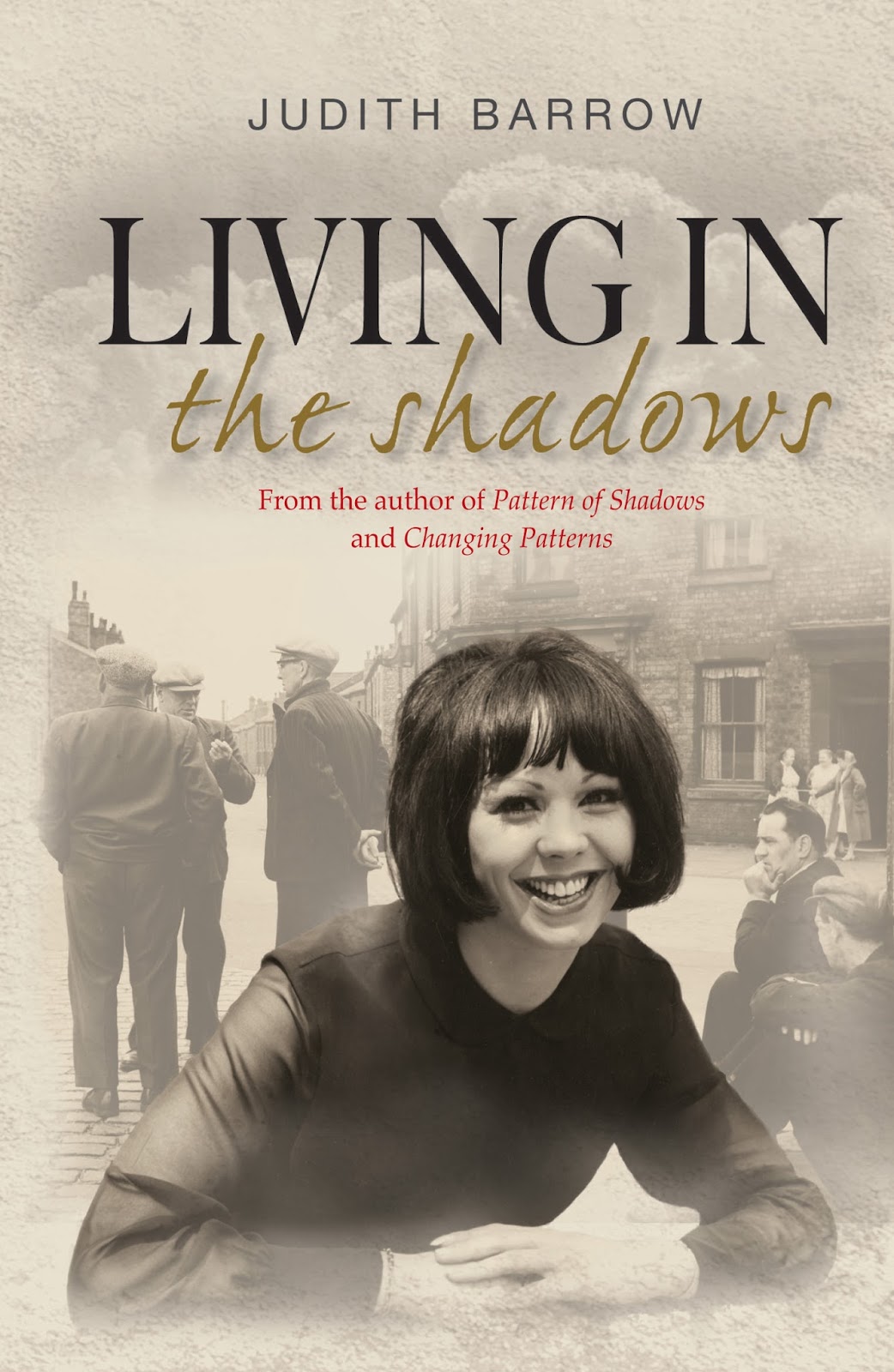
Living in the Shadows
by Judith Barrow

Publication Date: July 16, 2015
Honno Press
eBook & Paperback; 320 Pages
Genre: Historical Fiction/Family Saga


It’s 1969 and Mary Schormann is living quietly in Wales with her ex-POW husband, Peter, and her teenage twins, Richard and Victoria. Her niece, Linda Booth, is a nurse – following in Mary’s footsteps – and works in the maternity ward of her local hospital in Lancashire.

At the end of a long night shift, a bullying new father visits the maternity ward and brings back Linda’s darkest nightmares, her terror of being locked in. Who is this man, and why does he scare her so?

There are secrets dating back to the war that still haunt the family, and finding out what lies at their root might be the only way Linda can escape their murderous consequences.

Sequel to the acclaimed Changing Patterns and Pattern of Shadows.


ABOUT THE AUTHOR
Judith Barrow has lived in Pembrokeshire for thirty years. She is the author of three novels, and has published poetry and short fiction, winning several poetry competitions, as well as writing three children’s books and a play performed at the Dylan Thomas Centre. Judith grew up in the Pennines, has degrees in literature and creative writing and makes regular appearances at literary festivals.


Tour Schedule: http://hfvirtualbooktours.com/livingintheshadowsblogtour/
Hashtags: @LivingintheShadowsBlogTour #HistoricalFiction
Twitter Tags: @hfvbt @barrow_judith @honno

May 01, 2015

Chris Karlsen's Silk - Guest Post and {Giveaway}


A Muse With A Historical Bent

My father taught history. The politics, culture, and people of different periods was a common topic in our house. When I decided to do what I'd secretly wanted to try for many years, write, my long quiet muse went in search of people and events to build a world around.

Not all periods and places interest me while others have a strong draw for me. I write a Knights in Time series where a part of the story is set in medieval England and occasionally France. The battle of Poitiers, a great English victory fought in 1356, is the common denominator for those characters. My latest release, Silk, a suspense/thriller, is set in Victorian England, London in particular.

I chose Victorian London for a couple of reasons. So much changed over that time period, developments in industry and the expansion of the British Empire are two examples. The period conjures up both romantic images perfect for Christmas cards and menacing images of dark allies and people living hard lives. You could turn a corner and run into a polished carriage pulled by a handsome team of horses, or, you could turn a corner and run into Jack the Ripper. I thought it the most atmospheric of cities for my killer and detective to challenge each other.

Another reason I chose this time period (1888) was for my protagonist's personal history and quality of character. Several years ago, I had the occasion to visit the South Wales Borderers regimental museum. I was interested in the Zulu wars of 1879 and in particular two battles fought by that regiment: Isandhlwana and Rorke's Drift. Eleven Victoria Crosses, the equivalent of our Medal of Honor, were awarded to the men who fought at Rorke's Drift. After speaking at great length with the volunteers at the museum who gave me a private tour, I knew if I ever wrote a book, one day I'd use a veteran of this battle as the protagonist.

In Silk, Detective Inspector Rudyard Bloodstone was ill with a serious fever when the hospital station at Rorke's Drift was attacked by thousands of Zulu warriors. He managed to rise and fight after saving the lives of several men unable to walk on their own. As a result, he was awarded a Victoria Cross for "Extreme valour in the face of the enemy." Rudyard (Ruddy) keeps the medal and the queen's declaration in his sock drawer. He doesn't consider himself a hero. To him, he was just a soldier doing what was necessary in battle.

I treat settings like characters. They are living, breathing things. They evoke emotions the way the men and women in the story do. They can be beautiful and make you want to stay in that moment and place. Or, they can frighten as cold fog wraps around the human characters and the dark holds danger. In the Knights in Time books, I loved recreating medieval England without the iconic trappings so familiar with today: Big Ben, double-decker buses, black cabs, and tourists gathered around Buckingham Palace. In Silk, I loved showing London through the eyes of the different classes. The multi—facets of the city. One oddity I discovered in my research was an "entertainment" enjoyed by the middle class. There's scene in Silk that takes place in an asylum. I learned for a time asylums made a profit by letting so called normal folk view the lunatics (a common term used at the time) for a penny a tour.

I try to recreate the place and time by walking through it mentally. Every sidewalk my protagonist goes down, every room he or she enters I note the details along with them. Since I can't time travel in reality, I can travel through time on the page.  

About the book       
Genre: Thriller
Author: Chris Karlsen
Website: www.chriskarlsen.com
Publisher: Books to Go Now
Purchase on Amazon

London-Fall, 1888

The city is in a panic as Jack the Ripper continues his murderous spree. While the Whitechapel police struggle to find him, Detective Inspector Rudyard Bloodstone and his partner are working feverishly to find their own serial killer. The British Museum's beautiful gardens have become a killing ground for young women strangled as they stroll through.

Their investigation has them brushing up against Viscount Everhard, a powerful member of the House of Lords, and a friend to Queen Victoria. When the circumstantial evidence points to him as a suspect, Rudyard must deal with the political blowback, and knows if they are going to go after the viscount, they'd better be right and have proof.

As the body count grows and the public clamor for the detectives to do more, inter-department rivalries complicate the already difficult case.


About the author
Chris is a Chicago native. Her family moved to Los Angeles when she was in her late teens where she later studied at UCLA. She graduated with a Business Degree. Her father was a history professor and her mother a voracious reader. She grew up with a love of history and books.

Her parents were also passionate about traveling and passed their passion onto Chris. Once bitten with the travel bug, Chris spent most of her adult life visiting the places she'd read about and that fascinated her. She's had the good fortune to travel Europe extensively, the Near East, and North Africa, in addition to most of the United States.

After college, Chris spent the next twenty-five years in law enforcement with two agencies. Harboring a strong desire to write since her teens, upon retiring from police work, Chris decided to pursue her writing career. She currently writes three different series. Her historical romance series is called, Knights in Time. Her romantic thriller series is Dangerous Waters, and he latest book, Silk, is book one in her mystery/suspense series, The Bloodstone series.

She currently lives in the Pacific Northwest with her husband and five wild and crazy rescue dogs.

Website / Facebook / Pinterest / Trailer
Giveaway
Enter to win a Silk prize pack (via the Gleam form below) as follows:
One winner will be awarded:
a copy (print or kindle) of Silk
a swag bag
a $10 Amazon gift card
a Kindle copy of Knights in Time (the author's boxed set of historical romances)


* Giveaway is open internationally.
* Giveaway ends at 11:59pm on May 8th.
* You must be 18 or older to enter.
* Only one entry per household.
* All giveaway entrants agree to be honest and not cheat the system; suspicions of fraud will be decided upon by blog/site owner and the sponsor. Disqualified entrants are decided at our discretion.
* Winners will be chosen via GLEAM on or around May 9th and notified via email. Winners have 48 hours to claim prize or new winner is chosen.
* Please email Michelle @ hfconnection@yahoo.com with any questions.

Silk

April 23, 2015

Spotlight on David Morrell's Inspector of the Dead with Guest Post by Robert Morrison


Thomas De Quincey and the Afflictions of Childhood

Action and brilliant twists of plot are at the crux of David Morrell’s two historical thrillers, Murder as a Fine Art and Inspector of the Dead, both of which are set in 1850s London, and both of which feature assassins whose killing sprees are as ingenious as they are ruthless. What sets the two novels decisively apart from other Victorian murder mysteries, though, is the fictionalized presence of Thomas De Quincey (1785-1859), the notorious English author and opium addict.


Morrell seamlessly weaves details from De Quincey’s writings into the fabric of both novels, but he also exploits in full the circumstances of De Quincey’s remarkable life, as indeed De Quincey himself did in some of his finest essays. Born into prosperity, De Quincey exhausted his patrimony by the time he was 30 (primarily because he could not stop buying books), and spent much of the next forty years harried by debt and debt collectors. He read widely as a boy, and acquired a reputation as a brilliant classicist, especially in Greek. At 17 De Quincey bolted from Manchester Grammar School, and spent four harrowing months penniless and hungry on the streets of London. He entered Oxford University in 1803, but left five years later without taking his degree and moved to the English Lake District to be near his two literary idols, William Wordsworth and Samuel Taylor Coleridge. In 1813 De Quincey became dependent on opium, a drug he started experimenting with during his student days at Oxford, and over the next few years he sank deeper into debt and addiction, before launching himself as a professional writer.

It is, however, the close ties of his family life that most clearly fascinate Morrell. Death cast a terrible blight on De Quincey as a very young boy, and in many ways he never fully recovered. Before he was 8 he had lost his sister Jane, his father, and then another sister, Elizabeth, who was his dearest childhood friend, and whose sudden passing never ceased to haunt him. His portrait of Ann of Oxford Street, the young London prostitute he met as a teenage runaway, and his overwhelming sorrow at the death in 1812 of Wordsworth’s three-year-old daughter Catherine, are clearly shaped by his grief over Elizabeth’s death, as is Suspiria de Profundis (“Sighs from the Depths”), De Quincey’s great 1845 sequel to his Confessions.


In Murder as a Fine Art, Morrell memorably conjures the anguish of these losses in the scene where De Quincey enters Vauxhaul Gardens, and sickly prostitutes hired by the killer call out to him with names that bring his deepest griefs surging back to the surface: “I’m Ann!” one of the women yells. “No, I’m Ann!” cries another. “I’m Jane!” bawls a third. Then more voices and other deaths: “Elizabeth!” “Catherine!” “Love us, Thomas!” De Quincey sinks to his knees, unable to endure the memory of so much sorrow, and horrified to think that the assassin knows so well how to wound him.

Morrell is equally interested in De Quincey as a father. In 1806, as he wandered through the Lake District, the 21-year-old De Quincey made a manuscript list of twelve “Constituents of Happiness,” one of which was the “education of a child.” But by 1816, when he became a father for the first time, his life was already spiralling out of control, and in the years that followed he was often unable to provide for his wife Margaret and a family that grew ultimately to eight children. Perhaps most devastatingly, in 1834, as his teenage son William lay writhing in the grip of leukaemia, De Quincey listened as his son told the doctor of his physical pain, but also of his mental anguish, for the boy’s mind was full of “family distresses” – the fear, and penury, and despair that had surrounded him for his entire life. When William died, De Quincey’s grief – and guilt – were intense.

De Quincey’s youngest daughter Emily was twenty-one months old at William’s death, and while she never really knew him, she grew up like him in chaos – running from bill collectors, sneaking through back streets to deliver her father’s manuscripts to publishers, and watching helplessly as his drug addiction drove him down to rock-bottom. Yet by the 1840s the family’s finances had started to stabilize, thanks to the caution and courage of Emily and her two older sisters Margaret and Florence, all three of whom were devoted to De Quincey, but acutely aware of his failings. “I think no one will make much out of my father who does not take in the extreme mixture of childish folly joined to a great intellect,” Emily once declared.


In Inspector of the Dead, De Quincey’s relationship with Emily is center stage, and Morrell crafts marvellous exchanges between the two, as he plumbs the workings of their relationship, and demonstrates the ways in which Emily has been both constrained and liberated by her father. Yet perhaps the most moving moment in the novel comes when the two discuss – not the present or the future – but the traumas of the past, and De Quincey confesses his guilt. “In many ways, you are the parent, and I am the child,” he tells Emily. “I only wish that I had watched over you with as much devotion. I’m deeply sorry.” In such moments, Morrell brings De Quincey vividly before us, as a man who moved many to deep affection, despite courting the disasters that so often overtook him.

Morrell’s masterful handing of characterization and pace – his ability to combine heart-pounding action with forceful moments of pathos and emotional insight – are what distinguish both Murder and Inspector. De Quincey’s writings on drugs and violence are key to the process, but no less important are those incidents from his private life that both shattered and inspired him.

About the book
Publication Date: March 24, 2015
Mulholland Books
Hardcover; 342p
ISBN: 9780316323932
Genre: Historical Mystery

Add to GR Button

David Morrell’s MURDER AS A FINE ART was a publishing event. Acclaimed by critics, it made readers feel that they were actually on the fogbound streets of Victorian London. Now the harrowing journey continues in INSPECTOR OF THE DEAD.

Thomas De Quincey, infamous for his Confessions of an Opium-Eater,confronts London’s harrowing streets to thwart the assassination of Queen Victoria.

The year is 1855. The Crimean War is raging. The incompetence of British commanders causes the fall of the English government. The Empire teeters.

Amid this crisis comes opium-eater Thomas De Quincey, one of the most notorious and brilliant personalities of Victorian England. Along with his irrepressible daughter, Emily, and their Scotland Yard companions, Ryan and Becker, De Quincey finds himself confronted by an adversary who threatens the heart of the nation.

This killer targets members of the upper echelons of British society, leaving with each corpse the name of someone who previously attempted to kill Queen Victoria. The evidence indicates that the ultimate victim will be Victoria herself. As De Quincey and Emily race to protect the queen, they uncover long-buried secrets and the heartbreaking past of a man whose lust for revenge has destroyed his soul.

Brilliantly merging historical fact with fiction, Inspector of the Dead is based on actual attempts to assassinate Queen Victoria.

Praise for Inspector of the Dead
“Riveting! I literally thought I was in 1855 London. With this mesmerizing series, David Morrell doesn’t just delve into the world of Victorian England—he delves into the heart of evil, pitting one man’s opium-skewed brilliance against a society where appearances are everything, and the most vicious killers lurk closer than anyone thinks.” —Lisa Gardner, New York Times bestselling author of Crash & Burn and The Perfect Husband

What the Victorian Experts Say:

“Even better than Murder as a Fine Art. A truly atmospheric and dynamic thriller. I was fascinated by how Morrell seamlessly blended elements from Thomas De Quincey’s life and work. The solution is a complete surprise.” —Grevel Lindop, The Opium-Eater: A Life of Thomas De Quincey

“The scope is remarkable. Florence Nightingale, the Crimean War, regicide, the railways, opium, the violence and despair of the London rookeries, medical and scientific innovations, arsenic in the food and clothing—all this makes the Victorian world vivid. The way Morrell depicts Thomas De Quincey places him in front of us, living and breathing. But his daughter Emily is in many ways the real star of the book.” —Robert Morrison, The English Opium-Eater: A Biography of Thomas De Quincey

“I absolutely raced through it and couldn’t bear to put it down. I particularly liked how the very horrible crimes are contrasted with the developing, fascinating relationship between Thomas De Quincey and his daughter, Emily, who come across as extremely real. It was altogether a pleasure.” —Judith Flanders, The Invention of Murder: How the Victorians Reveled in Death and Detection and Created Modern Crime


About the Author
David Morrell is an Edgar, Nero, Anthony, and Macavity nominee as well as a recipient of the prestigious career-achievement Thriller Master away from the International Thriller Writers. His numerous New York Times bestsellers include the classic espionage novel. The Brotherhood of the Rose, the basis for the only television mini-series to be broadcast after a Super Bowl. A former literature professor at the University of Iowa, Morrell has a PhD from Pennsylvania State University. His latest novel is INSPECTOR OF THE DEAD, a sequel to his highly acclaimed Victorian mystery/thriller, Murder as a Fine Art, which Publishers Weekly called ”one of the top ten mystery/thrillers of 2013.”

For more information visit David Morrell’s website. You can also connect with him on Facebook and Twitter.


Visit the Tour Schedule
Hashtags: #InspectoroftheDeadBlogTour #HistoricalMystery
Twitter Tags: @hfvbt @_DavidMorrell

February 06, 2015

Tessa Arlen's Death of a Dishonorable Gentleman - Guest Post and {Giveaway}


Why does the Britain of the early 1900s intrigue and delight so many of us?

Today the great houses of Britain’s landed aristocracy with their vast, exquisite interiors and views of sweeping parkland attest to the power of rank and wealth of a bygone age. They also provide a stunning backdrop for elegantly clothed men and women with gracious manners who star in numerous costume dramas acquired for Masterpiece Theatre from the mother-lode of British television. We are presently enraptured by the first two decades of the 1900s.


Imagine you have been invited for a Saturday-to-Monday, as the Edwardians called a weekend, to one of their glorious country houses. Here is a little advice to bear in mind for your short stay, after all you might want to be invited back!


Whatever you do don’t alienate the servants: It is important not to underestimate how the Edwardians related to those who ensured their comfort and provided them with flawless and devoted service. Servants employed in the great houses were part of the family, but not of it; a sizeable distinction because it relies on generations of subtle understanding of the polite, but offhand tact, used by the uppers when they addressed the lower orders. Butlers, footmen and personal maids will be extraordinarily unforgiving if you wear incorrect attire for the country, and cruelly punishing if you are either patronizingly familiar or arrogantly dismissive. So beware! The butler and the housekeeper will be far more intimidating than the charmingly eccentric dowager duchess or that affable old colonel you will be seated next to when you arrive in time for tea.


Your Edwardian great-grandmother would have been able to give you some good advice. Huge pointers for your comportment this weekend would be restraint, restraint, and more restraint in a way we can’t begin to imagine today. Your great-grandmother would be the first to remind you to lower your voice to a well-modulated murmur, that it is rude to interrupt, or even be too enthusiastic. Do not comment on your surroundings, the magnificence of the house, or marvel at the deliciousness of your dinner. You are not on a ‘girls’ night out’, no matter how confiding and wickedly risqué your new Edwardian girlfriends appear to be, or how many glasses of wine the footman pours for you at dinner. So sorry I meant to say self-restraint – just place your hand palm down over your wine glass to indicate no thank you, when you feel a delighted shriek start to emerge.


This was a time when women were treated like goddesses . . . then they married and were kept at home to incubate an heir and a spare. While the men at your country house weekend enjoy shooting and fishing, you encouraged to watch and applaud, but not join to in. When they sit back to their port and a cigar after dinner your hostess will beckon you away with the other women – important that you go with them. Despite the luxurious existence of the early 1900s, most women today would find it impossible to live the hidebound, restricted life of early 20th century women. So after you have lugged in the groceries after a hard day at the office, made dinner and then helped the kids with their homework before putting them to bed, just in time to collapse on the sofa to catch an episode of Downton, try not to sigh too deeply when Mathew Crawley goes down on one knee in the swirling snow to propose to Lady Mary. Most of us would have been Ivy slogging away in the scullery and not Lady Grantham reading a novel in the drawing room!


Did the Edwardian Shangri-La portrayed in Downton Abbey really exist at all even for the upper classes? The short answer is ‘Yes’ if you were Lord Grantham and not his valet. If you have a problem not seeking to right the inequities of life, then don’t get on that train at London’s Marylebone station for the country. Certainly there were drunken, abusive husbands, negligent and thoughtless parents, spendthrifts and philanderers in the Edwardian age . . . and wronged wives looked the other way. The trick to coping with the darker side of human nature, if you were of society, was that it must never be referred to, never confided and most definitely never publicly acknowledged. However if you are an egalitarian at heart and social ostracism doesn’t bother you too much, you might join Mrs. Pankhurst’s suffragettes and militantly proclaim your opinions. I have heard that Holloway Prison was equipped with a special wing for militant members of the WSPU!


The third housemaid will unpack your trunk for you – five changes of clothes a day for three days need an awful lot of tissue paper. Here’s a titillating scrap of fresh society gossip to share with the company – gossip was the spice of Edwardian life. Gladys, the Marchioness of Ripon, an ultra-sophisticate with a ‘past’ was a wonderful example of the Edwardian double-standard and loved to gossip with her close coterie of friends. Alone in her lover’s house one day she discovered a pile of rivetingly indiscrete love letters written to him by one of her social adversaries, Lady Londonderry. Gladys swiped the lot and generously shared the juicy bits – read aloud after dinner – with her closest friends. After the fun was over she honorably returned the letters to their author at Londonderry House ─ when she knew husband and wife were dining alone. The butler approached his Lordship and handed over the ribbon-bound bundle. After studying the contents, in silence, Lord Londonderry directed him to carry the letters to the other end of the dining table. Silence still reigned as Lady Londonderry came to terms with her awful predicament, a silence that was never broken between the two of them again. Far worse than having an affair, Lady Londonderry had ‘Let down the side.’ Adultery was a fact of life, indiscretion unforgiveable; to be the subject of common gossip shameful and the scandal of divorce out of the question. Lord Londonderry never spoke to his wife in private again, and maintained a distant, cold courtesy to her in public for the rest of their long marriage - so much more entertaining than a splashy tabloid divorce!

I couldn’t resist writing a mystery of betrayal, blackmail and revenge set in 1900s England because of this wonderful double-standard in Edwardian England. There is nothing more delicious than putting a group of privileged elitists on the spot at a country house Saturday-to-Monday by subjecting them to a police enquiry as to where they were, and who they were with, at the time of death.

About the book
Publication Date: January 6, 2015
Minotaur Books
Formats: eBook, Hardcover
Genre: Historical Mystery

Add to GR Button

Lady Montfort has been planning her annual summer costume ball for months, and with scrupulous care. Pulling together the food, flowers and a thousand other details for one of the most significant social occasions of the year is her happily accepted responsibility. But when her husband’s degenerate nephew is found murdered, it’s more than the ball that is ruined. In fact, Lady Montfort fears that the official police enquiry, driven by petty snobbery and class prejudice, is pointing towards her son as a potential suspect.

Taking matters into her own hands, the rather over-imaginative countess enlists the help of her pragmatic housekeeper, Mrs. Jackson, to investigate the case, track down the women that vanished the night of the murder, and clear her son’s name. As the two women search for a runaway housemaid and a headstrong young woman, they unearth the hidden lives of Lady Montfort’s close friends, servants and family and discover the identity of a murderer hiding in plain sight.

In this enchanting debut sure to appeal to fans of Downton Abbey, Tessa Arlen draws readers into a world exclusively enjoyed by the rich, privileged classes and suffered by the men and women who serve them. Death of a Dishonorable Gentleman is an elegant mystery filled with intriguing characters and fascinating descriptions of Edwardian life—a superb treat for those who love British novels.

A Party for Winston, the second book in the series to be released in January 2016.

Praise for Death of a Dishonorable Gentleman
“Tessa Arlen has a worthy debut with Death of a Dishonorable Gentleman. With a deliciously gruesome murder and an unlikely pair of sleuths, this is a treat for fans of Downton Abbey who will want to devour it with a nice steaming pot of Earl Grey.” —New York Times bestselling author Deanna Raybourn

“In her debut novel, Tessa Arlen weaves an evocative tale of the passions, loyalties and ambitions that divide and unite two classes, upstairs and downstairs, in a stately home. She instantly transports the reader to Edwardian England.”—Christine Trent, author of Stolen Remains

“A dash of noblesse oblige sparkles between the upstairs/downstairs world of Lady Montfort and her housekeeper, Mrs. Jackson, as they work together to unmask the identity of a killer at large on the Montfort’s country estate. As sharp as a Nancy Mitford novel, Tessa Arlen’s sophisticated Death of a Dishonorable Gentleman deserves its place among the Great and the Good of classic mystery.”—Lyndsy Spence, founder of The Mitford Society and author of The Mitford Girls’ Guide to Life.

“Thoroughly enchanting. Arlen’s debut will appeal to fans of Downton Abbey, with its vivid descriptions, firm grip on the intricacies of the time period, and skilled portrayal of the often complicated relationship between upstairs and downstairs.” —Anna Lee Huber, author of the Lady Darby mystery series

Buy the Book


About the Author
TESSA ARLEN, the daughter of a British diplomat, had lived in or visited her parents in Singapore, Cairo, Berlin, the Persian Gulf, Beijing, Delhi and Warsaw by the time she was sixteen. She came to the U.S. in 1980 and worked as an H.R. recruiter for the Los Angeles Olympic Organizing Committee for the 1984 Olympic Games, where she interviewed her future husband for a job. DEATH OF A DISHONORABLE GENTLEMAN is Tessa’s first novel. She lives in Bainbridge Island, Washington.

For more information please visit Tessa Arlen’s website. Read Tessa Arlen’s blog at Redoubtable Edwardians. You can also connect with her on Facebook, Twitter, and Goodreads.

Subscribe to Tessa Arlen’s Newsletter.

Read my review of this fabulous book here.


Visit other blogs on the tour--Tour Schedule
Twitter Hashtag: #DishonorableGentlemanBlogTour #HistoricalMystery #HistFic
Twitter Tags: @hfvbt @MinotaurBooks @TessaArlen


Follow the instructions on the Gleam form below to enter for a chance to win a paperback copy of Death of a Dishonorable Gentleman by Tessa Arlen! (Open to U.S. only)


Death of a Dishonorable Gentleman

November 19, 2014

Mary F. Burns' The Spoils of Avalon - Guest Post and {Giveaway}


Doing Research OnSite – Wondrous Things Happen 

I spent three weeks in September visiting the main locations that are featured in my first Sargent-Paget mystery, The Spoils of Avalon: Lanercost Priory and Brampton Town in the north of England (Cumbria), and the village of Glastonbury with the ruins of the Abbey in Somerset in the south. I had anticipated having a good time, and learning some interesting facts, but I soon found myself overwhelmed by the deep sensory and spiritual experience of being alive in the places I had just spent a year writing about. I carried around with me an advance copy of my book and wrote in it constantly, making changes and adding scenes as the spirit moved me—and it often did!

In my book, I alternate between two time periods: 1877, with John Singer Sargent and Violet Paget, best friends from the age of 10, embarking on an adventure that takes them north to Cumbria, and which starts with murder and ends with magic; and 1539, in Glastonbury, with a young novice monk named Arthur Joseph, who witnesses the tragedy of the Dissolution of the Monasteries under King Henry VIII and Thomas Cromwell.

LANERCOST PRIORY


Built in 1169 by the Dacre family, the Priory was the home of Augustinian canons who, unlike monks in a monastery, did not live a cloistered life, but rather went out to the people in the surrounding areas, preaching and teaching and serving the poor.


When I first arrived at the site, which is now managed by the English Heritage Society, I was struck with the beauty and color of the old stonework. The ruins are unbelievably magnificent, and many of the stones used to built are said to be taken from the relatively nearby (1/4 mile up the hill) remains of Hadrian’s Wall, which was plundered of its dressed stone for many a century after the Roman soldiers left in the 300’s.


The Priory is set in the midst of rolling hills alive with numerous flocks of sheep and small herds of cattle that move from meadow to meadow throughout the day. Surrounded with the chirping of birds, roosters crowing, and jackdaws swooping and calling, the Priory begins to feel rather homey and domestic. After a very little while, however, I began to feel it was just exactly the right size, and felt very good just walking around the building and grounds. The baa-ing of the sheep, lowing of cattle, and the roosters and chickens clucking and carrying on made it feel timeless, as if these were the sounds that the people in the Middle Ages heard all day long, too. There were no airplanes overhead, and the car noises were relatively infrequent, especially after dusk.


Although the ruins are extensive, there is a considerable part of the original church that is still in use as an Anglican church today, St. Mary Magdalene--it had been repaired and maintained since the late 1500's, and still is home to parishioners and worshippers who are baptized, married and buried within its ancient walls.


Both sets of my characters, from both timelines, are visitors to Lanercost Priory after it has been laid waste, and I was deeply moved by standing in the forlorn and sacred space of a once-magnificent and holy place, and that experience allowed me to re-write some passages in my novel more authentically.

BRAMPTON 


The small town of Brampton is where John and Violet stay during their week-long visit to the North, and I was delighted to visit the village and see that it wasn’t very much different from how I had pictured it. It’s barely two miles from the ruins of Lanercost Priory, and as we drove back and forth on the (very) narrow road between the two places, I often pictured what it would be like to ride along in an open carriage, hearing the horse’s steps and the rattle of the carriage. I discovered that one such trip I had written about needed revising, as a castle that I had described as being “espied from the road” was in fact deep beyond some hills and woods, and could never be seen from that particular road!


Brampton itself is a nice little town with winding streets, and the tallest building is the church, St. Martin’s. It was designed and built by Philip Webb, an architect who worked for the Arts & Crafts firm of Morris & Co—and a very special element of the church is the presence of stunning stained glass windows designed by Edward Burne-Jones.


GLASTONBURY ABBEY


After a week at Lanercost and Brampton, we took a train down to Bristol, rented a car and drove the thirty miles or so to Glastonbury through a flat, watery country—Somerset, often called The Summer Land, and the ancient places where the legends of King Arthur, the Round Table, and the Holy Grail sprung forth from the Isle of Avalon, or the Isle of Glass.


Glastonbury has become rather commercialized, especially with the popularity of the summer outdoor concert, but also because of the thousands of people who flock there to find spiritual succor at its various holy and sacred sites: the Chapel of St. Michael on the Tor (meaning ‘hill’), the Chalice Well, the Thorn Tree of St. Joseph, and the ruins of the great Abbey itself.

September, which threatens rain every day, turned out to be a good time of year to visit, and none of the sites we visited were in the least bit overrun with people.


I was exceedingly lucky to be able to sign up for a day-long workshop on Gregorian Chant, which was held in the only building that was not destroyed during the Dissolution, the Abbot’s Kitchen. The professor of music who led the class taught us how to read the music, and we sang the Office of St. Dunstan (appointed as Abbot of Glastonbury in 943 by King Edmund) all during the day, learning the pieces bit by bit. I felt as if I had been transported to the 16th century, or earlier, and was experiencing a little of what the monks and other folk who lived at the Abbey did and felt in those times. This event also helped me fine-tune some scenes in my book, based on the sense of place and time I had experienced.


I have to say, though, that I don’t think I would have wanted to visit any of these site before I wrote my novel. I think it might have gotten in the way of actually writing the story, as if the scope and grandeur and beauty of these places would have overwhelmed and intimidated me. There’s no real way of knowing if that’s true or not, but I can say that I am very glad to have visited these places with my book in hand, and that making changes to the descriptions or scenes afterwards worked very well for me.

You can see a lot more photos and read about my research trip at my blog for this mystery series: www.sargent-pagetmysteries.blogspot.com. Thanks for reading, and I would be delighted to answer questions or read your comments!

About the book 
Publication Date: November 1, 2014
Sand Hill Review Press
Paperback; 300p
ISBN: 978-1937818289
Series: A John Singer Sargent/Violet Paget Mystery (Book One)
Genre: Historical Fiction/Historical Mystery

Add to GR Button

The death of a humble clergyman in 1877 leads amateur sleuths Violet Paget and John Singer Sargent into a medieval world of saints and kings—including the legendary Arthur—as they follow a trail of relics and antiquities lost since the destruction of Glastonbury Abbey in 1539. Written in alternating chapters between the two time periods, The Spoils of Avalon creates a sparkling, magical mystery that bridges the gap between two worlds that could hardly be more different—the industrialized, Darwinian, materialistic Victorian Age and the agricultural, faith-infused life of a medieval abbey on the brink of violent change at the hands of Henry VIII and Thomas Cromwell.

First in a new series of historical mysteries, The Spoils of Avalon introduces two unlikely detectives and life-long friends—beginning as young people on the verge of making their names famous for the next several decades throughout Europe and America: the brilliant and brittle Violet Paget, known as the writer Vernon Lee, and the talented, genial portrait painter John Singer Sargent.

Friends from the age of ten, Paget and Sargent frequently met in the popular European watering places and capitals, frequenting the same salons and drawing rooms in London, Rome, Paris, Florence, Venice, Vienna and Madrid. Both were possessed of keen minds and bohemian tendencies, unorthodox educations and outsized egos (especially Paget). Their instant, natural bonding led them to address each other as “Twin”, and they corresponded frequently when they were apart.

Henry James once described Violet Paget as having “the most formidable mind” of their times, and he was an active fan and patron of John Sargent, introducing him to London society and his own inner circles of literary and artistic genius.

Praise for The Spoils of Avalon
“An artist, a writer, a murder, a mysterious tome, a dissolving time, a crime, Arthurian legends, ancient saints books and bones. Burns’ prose drives and is sublime, with characters and settings that live on in your mind. This is an original historical mystery connecting the Age of Industry with the Age of Miracles.” – Stephanie Renée dos Santos, forthcoming novel: Cut From The Earth

Buy the Book
Amazon


About the Author
Mary F. Burns is the author of PORTRAITS OF AN ARTIST (Sand Hill Review Press, February 2013), a member of and book reviewer for the Historical Novel Society and a former member of the HNS Conference board of directors. A novella-length book, ISAAC AND ISHMAEL, is also being published by Sand Hill Review Press in 2014. Ms. Burns’ debut historical novel J-THE WOMAN WHO WROTE THE BIBLE was published in July 2010 by O-Books (John Hunt Publishers, UK). She has also written two cozy-village mysteries in a series titled The West Portal Mysteries (The Lucky Dog Lottery and The Tarot Card Murders).

Ms. Burns was born in Chicago, Illinois and attended Northern Illinois University in DeKalb, where she earned both Bachelors and Masters degrees in English, along with a high school teaching certificate. She relocated to San Francisco in 1976 where she now lives with her husband Stuart in the West Portal neighborhood. Ms. Burns has a law degree from Golden Gate University, has been president of her neighborhood association and is active in citywide issues. During most of her working career she was employed as a director of employee communications, public relations and issues management at various San Francisco Bay Area corporations, was an editor and manager of the Books on Tape department for Ignatius Press, and has managed her own communications/PR consulting business, producing written communications, websites and video productions for numerous corporate and non-profit clients.

Ms. Burns may be contacted by email at maryfburns@att.net. For more information please visit Mary Burns’s website. You can also connect with Mary on Facebook, Twitter, and Goodreads, or read her blog posts at:

www.genesisnovel.blogspot.com


Visit other blogs on the tour--Tour Schedule
Twitter Hashtag: #SpoilsofAvalonBlogTour #HistoricalFiction
Twitter Tags: @hfvbt @jwriter9

Follow the instructions on the Rafflecopter form below to enter for a chance to win one copy of The Spoils of Avalon (eBook or Print, Winner's choice), open to US, UK, Canada, and Australia residents.

a Rafflecopter giveaway

November 05, 2014

Sarah Kennedy's City of Ladies - Guest Post


Who Would’ve Thought?

Writing About Nuns and What I (Re)Learned Along the Way


We all know about nuns, right? They wear rather unattractive clothing, or they did before the Church relaxed its restrictions on dress in the late twentieth century. They are stern, upright, devout. They selflessly dedicate themselves to God and to helping others, without thought for their own comfort or pleasure.

Right?

Well, yes and no. I was raised Catholic, and many members of my family still attend the Roman Catholic church. Only one distant aunt was actually a nun, but we’ve all seen quite a few holy women up close and personal. So when I began my series, The Cross and the Crown, and decided to begin in a convent that was being dissolved by Henry VIII, I thought I would get a different look at nuns.

The nuns I have known are certainly devout women. They are also well-educated and often quite funny. Nuns work hard, both physically and mentally, and they often develop a hearty, earthy sense of humor to cope with the strains of daily life. They’re generally pretty healthy, emotionally, and they don’t hesitate to say what they think. Nuns get tired and cranky, like all of us, and sometimes they blow off steam. Sometimes they curse. Sometimes they tell a cutting truth.

When I began researching Renaissance nuns, I expected something more “old fashioned.” The Renaissance was a time of great religious piety, of course, even as the Church split into Roman Catholic and Protestant factions. Nuns tended to be more cloistered than is common nowadays. Women had fewer rights, and they were expected to be obedient—and quiet. So nuns would generally have been more meek. Wouldn’t they?
In fact, Renaissance nuns often became quite powerful women. The convents, though overseen by the male-dominated church hierarchy, were also relatively self-sufficient small communities, and day-to-day operations fell to the women who lived in them. Abbesses and prioresses were also managers, financial executives, and personnel directors; other nuns oversaw the business production of the convent; lay sisters often took care of the cooking and cleaning.

Convents were centers of business. The nuns cared for the sick, educated girls, employed local laborers, and traded in textiles, lumber, and farm animals. The women often excelled at needlework, manuscript copying and illuminating, and the raising of sheep and cows. All convents were sites of learning, and women who lived there had a much higher chance of becoming literate than those of any other class, except perhaps the royals.

When I began to dig more deeply into the nuns of sixteenth-century England, I was very surprised to find how meager the source material is. The biggest shock was to discover how many of these intelligent, well-educated women simply disappeared from the historical record. We know about a few, mostly from noble families, who returned to their original homes and, in keeping with Henrician law, remained single members of private houses. Many—we don’t know the numbers—surely escaped to the continent, as some records indicate that English nuns arrived in other European convents. A few records from East Anglia suggest that some nuns who either couldn’t or didn’t want to return to their birth families set up private, small households together and made their livings teaching local children or performing other acceptable “female” tasks like spinning, weaving, or selling farm goods.

I think inevitably of Mary Tudor, Henry VIII’s elder daughter, and Anne of Cleves, his fourth wife. Both of these women, while not nuns, stuck to their Roman Catholic beliefs. Mary suffered her father’s wrath and capitulated to him, at least in his presence. Anne, being the savvy politician that she was, also obeyed his dictates that she never marry after he divorced her and seems to have practiced her faith in private.

I don’t know of any credible sources that provide evidence of an uprising on the part of English nuns or of nuns actually taking part in any plots against the king or country. Mary Tudor tried to reverse the Reformation, but her bloody tactics earned her a post-mortem reputation for violence—and she was queen when she did it, after all. Anne died a beloved figure in the English court, but she remained a largely reserved person and kept her own counsel.

The information we have about the personalities of English nuns is derived largely from Reformation propaganda. Like the monks, they were characterized as luxury-loving, corrupt, lazy about their prayers, and lascivious in their personal lives. Is this true? Probably, for some. Others were undoubtedly holy in manners and thought. It’s difficult to read through politically-motivated descriptions.

At the same time, we also have the biographies of two notable religious women of an earlier period: Julian of Norwich and Margery Kempe. Julian seems to have been our ideal: selfless, God-centered, merciful, and original in her thinking. Margery was business-minded, sharp-tongued, sexually active, and vain about her clothes. They were both dedicated to understanding God and speaking about their religious experiences. One was mostly loved; the other often reviled.

This brings me to the one thing that has come through in my research is this: Roman Catholic women—and this surely includes the nuns—were, well, people. And like people today, including religious people, they were flawed, egotistical, and self-serving. They probably also got angry at each other, felt jealousy, and said unsavory things from time to time.

The Renaissance nuns, however, were also highly-respected, well-educated women who believed in their God and their calling. They worked hard, and they suffered under the king. Some made their way in court; others disappeared into the fog of time. I’ve tried, in both The Altarpiece and City of Ladies, the second book in my series, to show these many sides of Renaissance religious women. Does their tenacity continue to surprise me? Yes, it does. But it’s also familiar enough that I feel almost as though I know them, because they remind me, again and again, of women today.

ABOUT THE BOOK 
When we first met her in THE ALTARPIECE, Catherine Havens was a young Tudor nun seeking safety and a future. By the end of that novel, Catherine was safe but her future was decidedly uncertain. In CITY OF LADIES, Catherine is now a wife and mother. Her husband, William, is concerned that Catherine’s old friends—displaced nuns with nowhere else to go—are now a part of their home. He knows that dangerous whispers abound that Catherine and her friends have created a convent in a new form. When ladies go missing and as bodies turn up, William sends Catherine away in a scheme that will place them closer to court and hopefully closer to King Henry’s heart: he sends Catherine to Hatfield House to help in the care of little Elizabeth. The problem is that there is another guest in the house as well, one who has Catherine’s sympathies: Mary Tudor.

CITY OF LADIES is a suspenseful and beautifully told story of a young woman making her way during a treacherous time.

SELECTED PRAISE
“Having chosen William Overton, Catherine Havens Overton, in Book Two of the Cross and the Crown series, now struggles to manage her wifely duties in his house, where her extraordinary gifts in physic and healing are feared as witchcraft as well as sought after by all, creating a difficult and dangerous situation. Filled with drama, suspense, vivid scenes and larger-than-life characters, City of Ladies fast becomes impossible to put down….Kennedy is clearly as gifted as her main character, almost supernaturally at home in the 16th century as she combines the striking vocabulary of the time with her own poetic talents to create a rich and original tapestry of language. Such writing! Sarah Kennedy brings a lost world blazingly to life.”—Lee Smith

“….In City of Ladies Kennedy takes her place with Daphne du Maurier, Anya Seton, Rosemary Sutcliff, and Hilary Mantel as writer of superb historical fiction.” —Suzanne Keen, author of Empathy and the Novel

“Much of a historical novel’s success lies in the author’s ability to accurately cement the story in its time and place, and Kennedy excels in this aspect with detailed descriptions of the daily life of her characters, from clothing to architecture to medicine.…
It is not necessary to read the first novel in the series to enjoy this book, but those finding this their first introduction to Catherine will surely search out the first novel to spend more time with this feisty woman in her richly detailed world.”
—Foreword Reviews


ABOUT THE AUTHOR
Sarah Kennedy holds a Ph.D. in Renaissance Literature from Purdue University and an MFA in Creative Writing from Vermont College. The author of seven books of poems as well as The Altarpiece, book one in The Cross and the Crown series, she has received individual artist grants from the National Endowment for the Arts and the Virginia Commission for the Arts, as well as an award for scholarship from the National Endowment for the Humanities. She teaches at Mary Baldwin College in Virginia. Her website is http://sarahkennedybooks.wordpress.com/.

Find Sarah Online:

http://sarahkennedybooks.wordpress.com/

https://www.facebook.com/sarah.kennedy.520125

https://twitter.com/KennedyNovels

http://www.goodreads.com/author/show/6538009.Sarah_Kennedy