Showing posts with label Colin Falconer. Show all posts

March 23, 2015

Spotlight on Colin Falconer's The School of Night


Publication Date: October 7, 2014
Cool Gus Publishing
Formats: eBook, Paperback
Pages: 168
Series: The William Shakespeare Detective Agency
Genre: Historical Mystery

Add to GR Button

“My name is William Shakespeare. No, not that Shakespeare; and no jests please, I’ve heard them all. I’m the other one, the ne’er do well cousin, the loafer, known to family and friends as the dunce, the one who could not recite Cicero or Horace, who could never be as good as his clever cuz, the one who has just come to Bishopsgate from Stratford with silly dreams in his head and a longing to make something more of himself than just a glover’s handyman.”

What he finds in London is Lady Elizabeth Talbot, who is willing to pass a few shillings to this blundering brawler if he will help her find her husband. Poor William does not realize the trail will lead to the truth behind the death of Shakespeare’s great rival, Christopher Marlowe – or to a lifelong love affair with a woman far above his station.

Each book tells the story of William’s adventures as England’s first gumshoe, set against turbulent Elizabethan politics; of his romantic pursuit of the impossible Elizabeth Talbot; while charting the career of his up and coming dramatist cousin, the bard of Stratford, but just Will to his family.

Buy the Book


About the Author
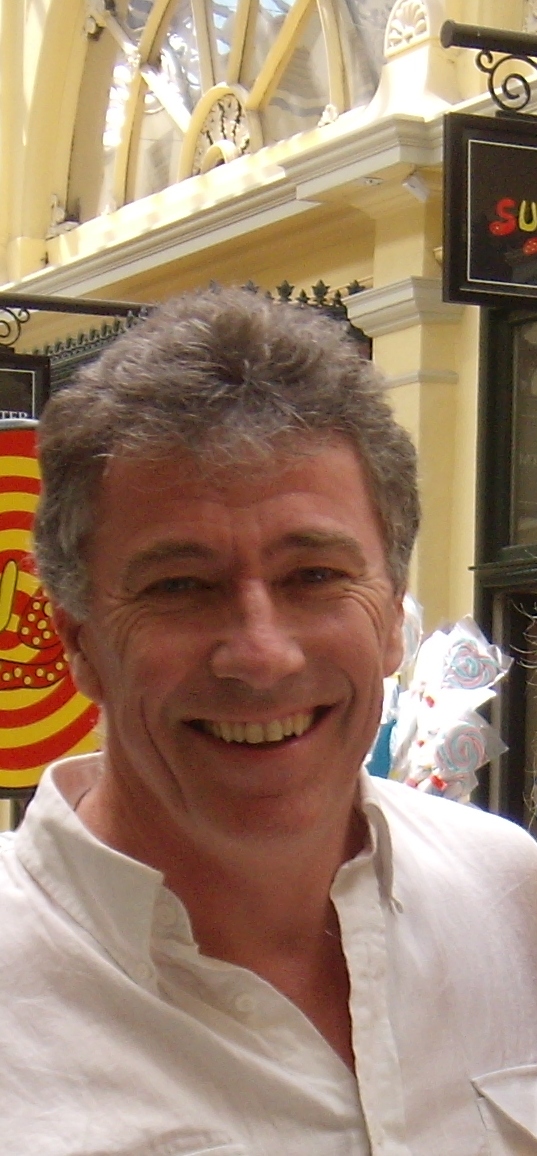
Born in London, Colin first trialed as a professional football player in England, and was eventually brought to Australia. He went to Sydney and worked in TV and radio and freelanced for many of Australia’s leading newspapers and magazines. He has published over twenty novels and his work has so far been translated into 23 languages.

He travels regularly to research his novels and his quest for authenticity has led him to run with the bulls in Pamplona, pursue tornadoes across Oklahoma and black witches across Mexico, go cage shark diving in South Africa and get tear gassed in a riot in La Paz.

He currently lives in Barcelona.

For more information please visit Colin Falconer’s website. You can also find him on Facebook or follow on Twitter.


Visit other blogs on the tour--Tour Schedule
Twitter Hashtag: #SchoolofNightBlogTour #HistoricalMystery #Historical
Twitter Tags: @hfvbt @colin_falconer

October 04, 2013

Colin Falconer's Isabella: Braveheart of France--Guest Post and {Giveaway}


Please welcome Colin Falconer in celebration of the release of his new novel, Isabella: Braveheart of France. 

It’s a thin line between love and hate
The story of Edward and Isabella
Colin Falconer

There’s a song originally recorded by The Persuaders in 1971 and covered many times since, most famously by Annie Lennox. It’s called ‘There’s a thin line between love and hate.’

It kept going round in my head when I first read the story of Edward and Isabella.

Isabella was the queen of Edward II of England. Their marriage had been arranged when she was just three years old to try and cement the truce between France and England over disputed territories in Gascony. 

Edward was a fine strapping fellow, by all accounts. She was only twelve years old when she married him but was destined to grow into a beautiful young woman. They were the glamour couple of the early fourteenth century, a Brangelina in the making. 

Edabella.

But two things stood in the way of their happiness and future success; Edward didn’t particularly want to be king of England and wasn’t really suited to the job; and he had fallen in love at first sight. 

But not with her.


The love of Edward’s life was a former squire named Piers Gaveston. Gaveston was murdered by some of Edward’s disaffected barons when she was seventeen and just growing into woman hood, so it may be that she thought that afterwards their marriage had a chance.

And it seemed that way for a short while. Edward performed his conjugal duties by England if not by her; they had four children over the course of the next decade. 

But it seems she never really won his love. She was replaced in his trust, if not his bed, by another of his court favourites, Hugh Despenser, and after the birth of her last child she became an increasingly lonely figure. He sent away her French retainers, separated her from her children and spent little time with her.


But finally, with the aid of her lover, Mortimer, she deposed him and he died at the hands of his captors in Berkeley Castle. Did she know about the planned murder beforehand? That we cannot know.

Did she come to hate him that much? It is an intriguing question.

More intriguingly - did she love him in the first place?

Isabella was an enigma. After Edward’s funeral at Gloucester Cathedral, she was given his heart in a silver casket. She had never had it in life; she owned it in death. When she herself died in 1358 she was buried, at her own insistence, in her wedding dress, holding the casket to her breast.

Edward’s cell at Berkeley castle
Photograph: David Stowell
How do we interpret such gestures? 

Did she wish him dead for spurning her, and when it was done did it trouble her conscience for the rest of her life?

Or was she, as history has painted her, a she-wolf, cold as the alabaster of her tomb, and everything done all for show.


It’s a thin line between love and hate. The heart in the casket. The wedding dress.

What did it mean? 

If it was all done for love, it would make their story one of the most poignant in English history.

If it was hate, it was the perfect revenge.

But we can never know, we can only guess. And historical novelists love to guess ...

About the book
ISABELLA, Braveheart of France, available now from Amazon US
And also available as POD from Cool Gus publishing.

"She was taught to obey. But will she learn to rebel?
Princess Isabella of France arrives at the English court to find her husband the king.
She is just 12 years old.
He is one of Europe's most handsome princes, tall young, athletic.
And deeply in love with another.
... another man.
She fights to win her husband's love as his reign descends into crisis after crisis.
To finally create her own destiny she must defy all England.
She must even defy God.
Will she do it?
And what will be the cost?"


About the author
Colin Falconer was born in North London, and spent most of his formative years at school playing football or looking out of the window wishing he was somewhere else.

After failing to make the grade as a professional football player, he spent much of his early years traveling, hitch-hiking around Europe and North Africa and then heading to Asia.

His experiences in Bangkok and India later inspired his thriller VENOM, and his adventures in the jungles of the Golden Triangle of Burma and Laos were also filed away for later, the basis of his OPIUM series about the underworld drug trade.

He later moved to Australia and worked in advertising, before moving to Sydney where he freelanced for most of Australia’s leading newspapers and magazines, as well as working in radio and television.

He started publishing in 1984, mostly humor and young adult fiction, but with the publication of VENOM in 1990, he became a full time novelist.

He has published over 40 books in print. HAREM was an enormous bestseller in Germany and THE NAKED HUSBAND was ranked #9 in Australia on its release.AZTEC stayed on the bestseller lists in Mexico for four months. He is a bestseller in Europe and his work has sold into translation in 23 countries: Brazil, Belgium, Bulgaria, the Czech republic, Croatia, France, Germany, Greece, Hungary, Italy, Indonesia, Korea, Macedonia, Montenegro, Mexico, Poland, Portugal, Romania, Serbia, Slovakia, Slovenia, Spain and Turkey.

He lived for many years in the beautiful Margaret River region in WA, and helped raise two beautiful daughters with his late wife, Helen. While writing, he also worked in the volunteer ambulance service for over 13 years His marriage ended in tragic circumstances, a story he has told in ‘The Naked Husband,’ and its non-fiction sequel, ‘The Year We Seized the Day,’ written with a writing partner, Elizabeth Best.

He travels regularly to research his novels and his quest for authenticity has led him to run with the bulls in Pamplona, pursue tornadoes across Oklahoma and black witches across Mexico, go cage shark diving in South Africa and get tear gassed in a riot in La Paz. He also completed a nine hundred kilometre walk of the camino in Spain.

He did not write for over five years but returned to publishing in 2010 with the release of SILK ROAD, and then STIGMATA the following year. ISABELLA is due to be published in 2013.

His likens his fiction most closely to Ken Follett – books with romance and high adventure, drawn from many periods of history.

Visit Colin at his WEBSITE.

Follow the instructions on the Rafflecopter form below to enter for a chance to win one of three eBook copies of Isabella by Colin Falconer!

a Rafflecopter giveaway

December 09, 2011

Guest Post and Giveaway: Harem by Colin Falconer


You are young and you are beautiful. You have been captured by the Turks after your Balkan city succumbed to a long siege. Your father and brothers are dead. You are terrified you will now be raped and murdered.

But you are not harmed by your captors, fearsome as they look. Instead you are taken back to the Ottoman capital and introduced into a gloomy wooden palace the Turks call the Eski Saraya. 

You are put into the care of the Mistress of the Robes, where your flair for needlework is put to good use. You are taught Arabic and the Koran. But it is made clear to you that you are now a slave. Whatever high position in life you had before, now you are nothing; the Sultan's plaything. 

You accept that will never see your own country again. This is your home now and there are only two ways out of this dreary place. If you do not attract the Sultan's eye he may one day give you away as a wife to one of his senior officers or ministers. But that's if you're lucky. You might just as easily be neglected and forgotten.

Or you can turn the tables.

You soon realize that these other women who share your predicament are your competition. One of them is going to be the mother of the next Sultan and attain a position of pre-eminent power in the country that enslaved her. If you are beautiful enough and clever enough and cunning enough that woman could be you.

The first step is to become gözde - 'in the eye'; that is, you must catch the attention of the Lord of Life, the Sultan himself. An ambitious girl like yourself might find a way. It depends how devious you are. 

Or you may rely on kismet, fate. One day you will wait with a hundred other girls in the court of the harem, pearls and jewels glittering in the sun. As the Sultan passes among you, he will take a handkerchief from the sleeve of his robe and drape it over your shoulder. You have been chosen! This is your golden chance. 

You may have one night and be forgotten; or this could be the road to absolute power. It is entirely up to you.

You are taken first to the Keeper of the Baths, your entire body is shaved by slave girls and you are bathed in water scented with jasmine and orange. Your hair is shampooed with henna. Afterwards another slave coats your body with a mixture of warm rice flour and oil. 

You are then prepared and coiffed and primped down to the last eyelash and the last drop of balm, dressed elaborately in clothes of incredible richness. Finally the Chief Black Eunuch escorts you to the Sultan's bedchamber. 

If you can please the Lord of Life then he might invite you back to his bed again. If the invitations become more frequent then you become iqbal, a favourite, and you won't have to sleep with the rest of these girls.

You are given your own apartments, your own eunuch slaves, even an allowance of your own. You are on your way. But it will all count for nothing unless you get pregnant and bear the Sultran a son. If you do, then you become a kadin, one of the Sultan's wives. You are now playing this deadly game in earnest because there are only ever four kadins. After that, the abortionist is called in. 

As one of the select four you are just a breath away from power now. You are also in deadly danger.

Only one of you can become the mother of the next Sultan, the Sultan Valide. If you do, your power will be unquestioned, you will rule the entire Harem and your son will reign supreme in the country that made you a slave. 

If you fail? You will probably end up at the bottom of the Bosphorus, drowned in a sack. So you cannot afford to fail. You must be clever and you must be charming and you must be attractive and you must be utterly ruthless.

These are your choices. This is the game. 

This is the harem.


Colin Falconer has been published widely in the UK, US and Europe and his books have been translated into seventeen languages. You can find him at his blog at http://www.colin-falconer.blogspot.com/ or his web page at http://www.colinfalconer.net/ 


Leave a comment for a chance to win an eBook copy of HAREM.  Giveaway will end on December 26, 2011 at 11:59pm CST.  Open worldwide.

July 01, 2011

Colin Falconer Guest Review of Wolf Hall by Hilary Mantel

Please welcome back author Colin Falconer to Historical Fiction Connection.  He is the author of the upcoming novel Silk Road.

REVIEW OF WOLF HALL by HILARY MANTEL

COLIN FALCONER

It’s rare these days to find an historical novelist who hasn’t written about the Tudors. The story of Henry VIII and Elizabeth I is rich with intrigue, heaving bosoms, treachery, huge codpieces, starched ruffs, and pale, ambitious, doomed women. Desperate Housewives meets the Rack. You would think that with the number of words - and furlongs of celluloid - dedicated to their story, even just over the last two decades, that the harvest was in, the cellar empty, the bottle dry.

So it was with no little reserve that I approached Hilary Mantels’ WOLF HALL. What else was there to say about the Tudors? Well, quite a lot, apparently.

The novel’s back drop is a defining moment in British history, when Henry wrested power away from the Catholic Church and allowed Britain to worship - and think – for itself. But Bluff King Hal was not motivated by great religious purpose; he was simply in love with a younger woman and wanted a son and heir. He was, as Mantel paints him, a man terrified for his immortal soul but not so concerned that he was going to let anyone – even God - stand in his way.

WOLF HALL follows the contest between Henry and his first wife, Catherine of Aragon; between the Pope and the King; between Thomas More and Thomas Cromwell. But this isn’t the story; this is just the plot. The world to which we are allowed entry is not that of Henry VIII, or the Boleyns, but the much maligned Thomas Cromwell.

We follow his rise from a Putney blacksmith’s son to the second most powerful man in England and if that was all the narrative, it would have made an adequate Jeffrey Archer novel. In Mantel’s hands it becomes something else.

I was prepared for a long and tedious beginning. After all, didn’t this win the Man Booker Prize in 2009? The cast list of the characters at the beginning reads like the telephone listing of a small town. When I picked it up, my heart sank.

I expected the opening paragraph to be a long description of a vase. Instead, on the first page, we meet Thomas Cromwell as a teenager, being kicked unconscious on the cobblestones by his father. Hard not to cheer for him; stay down, son, stay down. If you try and get up again, the next boot will kill you.

His married sister dresses his injuries and he escapes on a boat to France. The next time we encounter him he is chief counsel to the king’s chief counsellor, Cardinal Wolsey. It's a long way from the mud and blood of the Putney yard, but Cromwell isn’t done yet. He is the ultimate fixer, the man who gets things done. “He can draft a contract, train a falcon, draw a map, stop a street fight, furnish a house and fix a jury." He also knows the New Testament by heart. While Wolsey and More crumble under the press of the king’s tantrums and whimsies, Cromwell endures and prevails. When Cromwell falls gets sick the king pays a personal visit to his home to see him well again. Even his bitterest enemies come to rely on him.

Much of Cromwell's history is told in quicksilver flashbacks. They beg more questions than they answer and add to his allure, allowing the reader to recreate the man in their own mind. We expect a monster with a heart like an abacus; instead Mantel shows us an enforcer who champions tolerance, a free-thinker who still ensures that the king has his way. His affection for his family, his ward - even his enemies - disarms. In finding charity in one of history’s villains, she has found the unseen aspect of Henry’s story and rendered it utterly fresh.

In fact she relegates the king and all those wives as well as the religious future of England to an afterword; it’s Cromwell’s fate that captivates. We never do go to Wolf Hall though we sense that is where his fortunes will finally turn.

This is a beautiful and surprisingly tender book. The assumption is that there will be a sequel but I hope she will leave this work to stand alone. We all know that Cromwell came to a nasty end and this lends poignancy to the book’s enigmatic ending.

This is not so much a novel as a portrait, the artist capturing a great man in his moment of pre-eminent glory just before tragedy overtakes him. “Lock Cromwell in a deep dungeon, says Thomas More, and when you come back that night he’ll be sitting on a plush cushion eating larks’ tongues, and all the gaolers will owe him money.” It is the sense of doom unforeseen that lends brilliance to the artist’s precise brushwork.

If you are looking for a bodice ripper or a Ken Follett saga, this is not for you. Mantel’s overuse of the personal pronoun may also drive you to distraction. Who said what? But this time the Booker judges got it exactly right. Cromwell may well charm you in the same way he seduced Henry’s court. When the book ends it is like saying goodbye to an old friend.

Colin Falconer's When We Were Gods - the story of Cleopatra, has just been re-released on Kindle for $5.99. His new novel Silk Road, will be published by Corvus Atlantic on October 1. To find out more, see http://www.colinfalconer.net  and his blog: http://www.colinfalconer.net/the-man-with-the-past.html

June 24, 2011

Guest Post: Colin Falconer, author of the upcoming novel Silk Road

Please welcome author Colin Falconer to Historical Fiction Connection. He is the author of the upcoming novel Silk Road.


CLEOPATRA: A MIRROR TO THE PRESENT

Colin Falconer

Cleopatra has been an object of fascination for writers, artists and film directors down the centuries.

But in her book, ‘Cleopatra, Queen Lover Legend’ Lucy Hughes-Hallet contends that every story written about her, and every picture painted of her, said more about the artist and the times they lived in than they did about the woman herself.

Cleopatra has been variously portrayed as virtuous suicide, inefficient housewife, exuberant lover, professional courtesan, scheming manipulator, and femme fatale. Was she Shakespeare’s cruel and lazy siren, Shaw’s man-eater or Taylor’s alluring beauty? Or does she rather, as Hughes suggests, only represent those aspects of the female that has most challenged each era since her death?

Cleopatra’s fiction was first formulated in her own lifetime by her enemies' propaganda. Its primary purpose was to discredit her lover Mark Antony. Antony’s rival, Augustus, claimed he had become so besotted with the Queen of Egypt that she had virtually emasculated him. He profited by denigrating Antony to his fellow Romans as a hedonist and a traitor, for in Rome - unlike in Egypt - women were considered inferior, lacking in virtue and intelligence.

And so Cleopatra became the dangerous feminine that can lure a helpless man from his duty to pursue the forbidden; and over the next two millennia she came to be the mirror in which each age saw its women.

In the fourteenth century, for example, Chaucer painted her as the very paragon of feminine virtue; the proof of her goodness being that she didn't wish to outlive her man. In an age when love-matches were rare and widowhood the only condition in which a woman could be truly independent, her great virtue, it seemed, was that she didn’t want to live longer than Anthony did.

But by the time of the Renaissance, with art and society dominated by themes of the sacred and the profane, Cleopatra’s bare breasts and the phallic asp became a dominant motif for many artists. The significance of her ritual suicide was overwhelmed by the imagined manner of it.
Later, as the American and French revolutions gripped eighteenth century Europe and North America, her story evolved into the clash between rival systems of government. Cleopatra and Antony represented the feudal nobility opposed to Octavius's centralising and modernising regime.

By colonial times she had transformed yet again, was depicted in gauzy harem pants and sparkly bra, like a dusky Lady Gaga, lolling indolently on a divan, representing a terminally decadent culture ripe for annexation by a benignly virgin western power.

In the Victorian era Cleopatra was reborn yet again as femme fatale, flouter of every convention, breacher of every taboo. To an increasingly rigid and regulated society, she was at once both evil and delightful, a powerful antidote to male sexual guilt.

The image persisted into 1930’s Hollywood. Cecil B de Mille offered the leading role in his movie about her to Claudette Colbert with the words: "How would you like to play the wickedest woman in history?" By this time "wicked" had become a term of approbation - sexy, edgy, titillating. The wickedest woman in history? The real Cleopatra was politically astute, a genius at diplomacy and an brilliant administrator – but how can that ever stack up against a sparkly bra?

By the time of the notorious 1963 movie with Elizabeth Taylor and Richard Burton the tragedy of her reign had devolved to history's best-ever holiday romance.

Hughes has made a very good point; Cleopatra is not as much a woman as an idea. Historians know what she did and what happened to her, but the interpretation of her history depends largely on the writer or artist and the times they live in.

But what was she really like?

Perhaps only Liz Taylor will ever know.

Colin Falconer's When We Were Gods - the story of Cleopatra, has just been re-released on Kindle for $5.99. His new novel Silk Road, will be published by Corvus Atlantic on October 1. To find out more, see http://www.colinfalconer.net  and his blog: http://www.colinfalconer.net/the-man-with-the-past.html