Showing posts with label historical mystery. Show all posts

October 23, 2015

Spotlight on Candace Robb's Margaret Kerr Mystery Series {Giveaway}


Please join Margaret Kerr as she tours the blogosphere for her Margaret Kerr Mystery Series, from October 12-23, with HF Virtual Book Tours, and enter to win one of three (3) Sets of A TRUST BETRAYED and THE FIRE IN THE FLINT in eBook!

BETRAYED and THE FIRE IN THE FLINT in eBook!


A Trust Betrayed (Book One)


“Thirteenth-century Edinburgh comes off the page cold and convincing, from the smoke and noise of the tavern kitchen to Holyrood Abbey under a treacherous abbot. Most enjoyable.”—THE LIST

In the spring of 1297 the English army controls lowland Scotland and Margaret Kerr’s husband Roger Sinclair is missing. He’d headed to Dundee in autumn, writing to Margaret with a promise to be home for Christmas, but it’s past Easter. Is he caught up in the swelling rebellion against the English? Is he even alive? When his cousin, Jack, is murdered on the streets of Edinburgh, Roger’s last known location, Margaret coerces her brother Andrew, a priest, to escort her to the city.

She finds Edinburgh scarred by war—houses burnt, walls stained with blood, shops shuttered—and the townsfolk simmering with resentment, harboring secrets. Even her uncle, innkeeper Murdoch Kerr, meets her questions with silence. Are his secrets the keys to Roger’s disappearance? What terrible sin torments her brother? Is it her husband she glimpses in the rain, scarred, haunted? Desperate, Margaret makes alliances that risk both her own life and that of her brother in her search for answers. She learns that war twists love and loyalties, and that, until tested, we cannot know our own hearts, much less those of our loved ones.


The Fire in the Flint (Book Two)

“Intrigue abounds…. Robb’s captivating blend of history and mystery vividly evokes medieval Scotland.” —BOOKLIST

Scots are gathering in Murdoch Kerr’s Edinburgh tavern, plotting to drive out the English forces. Margaret takes her place there as innkeeper, collecting information to pass on to William Wallace—until murder gives the English an excuse to shutter the tavern. The dead man was a witness to the intruders who raided chests belonging to Margaret’s husband and her father, the latest in a string of violent raids on Margaret’s family, but no one knows the identity of the raiders or what they’re searching for.

Margaret’s uncle urges her to escape Edinburgh, but as she flees north with her husband Roger, Margaret grows suspicious about his sudden wish to speak with her mother, Christiana, who is a soothsayer. Margaret once innocently shared with Roger one of Christiana’s visions, of “the true king of Scotland” riding into Edinburgh. Now she begins to wonder if their trip is part of a mission engineered by the English crown…


A Cruel Courtship (Book Three)

“This is history as it should be told!” —GOOD BOOK GUIDE

In late summer 1297, Margaret Kerr heads to the town of Stirling at the request of William Wallace’s man James Comyn. Her mission is to discover the fate of a young spy who had infiltrated the English garrison at Stirling Castle, but on the journey Margaret is haunted by dreams—or are they visions?—of danger.
He who holds Stirling Castle holds Scotland—and a bloody battle for the castle is imminent. But as the Scots prepare to cast off the English yoke, Margaret’s flashes of the future allow her to glimpse what is to come—and show her that she can trust no one, not even her closest friends.

A CRUEL COURTSHIP is a harrowing account of the days before the bloody battle of Stirling Bridge, and the story of a young woman’s awakening.


ABOUT THE AUTHOR
Growing up, Candace Robb wanted to be a ballerina, tap dancer, folk singer, journalist—but on the day that she walked into Liz Armstrong’s undergraduate class on Chaucer’s Troilus and Criseyde, that all changed. A gifted teacher, lively, witty, always laughing even when cringing at a lazy response, Dr. Armstrong launched into the opening stanzas, and within a few lines Candace’s ears adjusted to the middle English—and she was hooked. Chaucer’s psychological study of the two lovers was a revelation to her. The next quarter was The Canterbury Tales. That clinched it. Candace went on to graduate work in medieval history and literature, and ever since she’s been engaged in bringing to life the rich culture of the period, from the arts to the politics. She is the internationally acclaimed author of thirteen crime novels featuring the sexy, brooding, clever Owen Archer, who solves crimes for John Thoresby, Archbishop of York and Lord Chancellor of England, and the young Margaret Kerr, searching for her missing husband and her role in a Scotland overrun by English soldiers. Candace is currently under contract with Pegasus Books for a new crime series set in 15th century York, the Kate Clifford mysteries, which will debut in 2016.

Writing as Emma Campion, Candace has published two historical novels about the women of the English court in the 14th century, A Triple Knot and The King’s Mistress.

Born in the Blue Ridge Mountains of North Carolina, Candace grew up in Cincinnati, Ohio, and has lived most of her adult life in Seattle, Washington, which she loves for its combination of culture, natural beauty, and brooding weather so like Yorkshire, Wales, and Scotland, which she visits as often as possible. She has taught the art of writing the crime novel in the University of Washington’s certificate program, and offers workshops in writing the historical novel and in creating and plotting the crime series. Candace (and Emma) blog about writing and medieval topics at A Writer’s Retreat, ecampion.wordpress.com.


Tour Schedule: http://hfvirtualbooktours.com/margaretkerrmysteryseriesblogtour/
Hashtags: #MargaretKerrMysterySeriesBlogTour #CandaceRobb #Historical #Mystery
Twitter Tags: @hfvbt @CandaceMRobb @DiversionBooks

GIVEAWAY
To win one of three (3) Sets of A TRUST BETRAYED and THE FIRE IN THE FLINT in eBook, enter using the Rafflecopter Widget below.
Rules
– Giveaway ends at 11:59pm EST on October 23rd. You must be 18 or older to enter.
– Giveaway is open internationally.
– Only one entry per household.
– All giveaway entrants agree to be honest and not cheat the systems; any suspect of fraud is decided upon by blog/site owner and the sponsor, and entrants may be disqualified at our discretion
– Winner has 48 hours to claim prize or new winner is chosen.

a Rafflecopter giveaway

September 11, 2015

Amy Stewart's Girl Waits With Gun - Spotlight and {Giveaway}

WINNER - DIANA


Girl Waits With Gun by Amy Stewart

Publication Date: September 1, 2015
Publisher: Houghton Mifflin Harcourt
Formats: Ebook, Hardcover
Genre: Historical Fiction/Mystery


From the New York Times best-selling author of The Drunken Botanist comes an enthralling debut novel based on the forgotten true story of one of the nation’s first female deputy sheriffs.

Constance Kopp doesn’t quite fit the mold. She towers over most men, has no interest in marriage or domestic affairs, and has been isolated from the world since a family secret sent her and her sisters into hiding fifteen years ago. One day a belligerent and powerful silk factory owner runs down their buggy, and a dispute over damages turns into a war of bricks, bullets, and threats as he unleashes his gang on their family farm. When the sheriff enlists her help in convicting the men, Constance is forced to confront her past and defend her family — and she does it in a way that few women of 1914 would have dared.

PRAISE
“A sheer delight to read and based on actual events, this debut historical mystery packs the unexpected, the unconventional, and a serendipitous humor into every chapter. Details from the historical record are accurately portrayed by villains and good guys alike, and readers will cross their fingers for the further adventures of Constance and Sheriff Heath. For fans of the Phryne Fisher series by Kerry Greenwood, and the Mary Russell and Sherlock Holmes mysteries by Laurie R. King.”—Booklist, starred

“Stewart crafts a solid, absorbing novel based on real-life events—though they’re unusual enough to seem invented. Stewart deftly tangles and then unwinds a complicated plot with nice period detail…More adventures involving gutsy Constance, quietly determined Sheriff Heath, and a lively cast of supporting characters would be most welcome.”—Kirkus, starred

“In her engaging first novel, Stewart (The Drunken Botanist) draws from the true story of the Kopp sisters (Constance became one of the country’s first female deputy sheriffs) and creates a welcome addition to the genre of the unconventional female sleuth. Colorful, well-drawn characters come to life on the page, and historical details are woven tightly into the narrative. The satisfying conclusion sets up an opening for future Constance Kopp novels. VERDICT: Historical fiction fans and followers of Rhys Bowen’s ‘Molly Murphy’ mysteries and Victoria Thompson’s ‘Gaslight Mystery’ series will delight in the eccentric and feisty Kopp women.”—Library Journal, starred

“A smart, romping adventure, featuring some of the most memorable and powerful female characters I’ve seen in print for a long time. I loved every page as I followed the Kopp sisters through a too-good-to-be-true (but mostly true!) tale of violence, courage, stubbornness, and resourcefulness.”—Elizabeth Gilbert, author of Eat, Pray, Love

“How could you not fall in love with a book about one of the first female deputy sheriffs and her sisters–especially when it’s written by the enthralling Amy Stewart? Full of long-held secrets, kicked-up dust, simmering danger, and oh yes, that gun—this gritty romp illuminates one of history’s strongest women with a hold-your-breath panache.”—Caroline Leavitt, New York Times bestselling author of Is This Tomorrow and Pictures of You

“Girl Waits With Gun makes excellent use of history to put a fresh spin on classic cop-and-crook types. Amy Stewart’s true-life protagonist is a ‘rough and tumble’ version of the early 20th century’s New Woman. She is witty, sharply-drawn, and suffers no fools!”—Suzanne Rindell, author of The Other Typist

“Yowza! Amy Stewart’s debut boasts pomaded gangsters, pistol-packin’ dames, kidnappings, shots in the dark, and everything from Girls Gone Wrong to carrier pigeons finding their way home. You might want to stay up all night reading, you might want to lie down on your fainting couch with a cool cloth on your forehead. Either way, you’ll have the time of your life.” —Robert Goolrick, New York Times bestselling author of A Reliable Wife

“Girl Waits with Gun is fresh, funny and utterly compelling– and Constance Kopp and her sisters are not just great investigators, but completely original women. It was a blast from start to finish and I can’t wait to see what Deputy Kopp gets up to next.”— Lisa Lutz, author of The Spellman Files, How to Start a Fire, and others

“Amy Stewart has crafted the best kind of historical novel; she uncovers an intriguing, all-but-forgotten historical nugget and spins it into a wildly entertaining tale with an engaging, tough-minded heroine. Girl Waits With Gun hits the bulls-eye.”—Daniel Stashower, author of The Hour of Peril: The Secret Plot to Murder Lincoln Before the Civil War

“Amy Stewart’s debut novel Girl Waits With Gun is an irresistible and thoroughly enjoyable book, a suspenseful historical mystery spiced with marvelous characters, wit, and humor. Is it too soon to beg for a sequel?” —Jennifer Chiaverini, author of Mrs. Grant and Madame Jule

“Engaging, lively, and substantive, Girl Waits with Gun is a perfect mystery, and the Kopp sisters are my new best friends. Amy Stewart writes about crime as well as she writes about plants and poisons. I loved this book, and will be first in line for the next installment.”—Sara Gran, author of Claire DeWitt and the Bohemian Highway

ABOUT THE AUTHOR
Amy Stewart is the author of seven books. Her latest, Girl Waits With Gun, is a novel based on a true story. She has also written six nonfiction books on the perils and pleasures of the natural world, including four New York Times bestsellers: The Drunken Botanist, Wicked Bugs, Wicked Plants, and Flower Confidential. She lives in Eureka, California, with her husband Scott Brown, who is a rare book dealer. They own a bookstore called Eureka Books. The store is housed in a classic nineteenth-century Victorian building that Amy very much hopes is haunted.

Stewart has written for the New York Times, the Washington Post, and many other newspapers and magazines, and has appeared frequently on National Public Radio, CBS Sunday Morning, and–just once–on TLC’s Cake Boss. She is the recipient of a National Endowment for the Arts fellowship, the American Horticulture Society’s Book Award, and an International Association of Culinary Professionals Food Writing Award.

For more information visit Amy Stewart’s website. You can also find her onFacebook, Twitter, Goodreads, and Pinterest.


Tour Schedule: http://hfvirtualbooktours.com/girlwaitswithgunblogtour/
Hashtags: #GirlWaitsWithGunBlogTour #HistoricalFiction #Mystery
Twitter Tags: @hfvbt @HMHBooks @Amy_Stewart

GIVEAWAY: One paperback copy. Open to US residents only. To enter, leave a comment telling us what intrigues you about this book. Last day to enter - September 25, 2015.
Rules

– Must be 18 or older to enter.
– Only one entry per household.
– All giveaway entrants agree to be honest and not cheat the systems; any suspect of fraud is decided upon by blog/site owner and the sponsor, and entrants may be disqualified at our discretion.

May 25, 2015

Spotlight on John A. Connell's Ruins of War


Title: “Ruins of War”
Author: John A. Connell
Release date: May 5, 2015
Publisher: Berkley/Penguin Books
ISBN: 978-0425278956

Winter 1945. Seven months after the Nazi defeat, Munich is in ruins. Mason Collins—a former Chicago homicide detective, U.S. soldier, and prisoner of war—is now a U.S. Army criminal investigator in the American Zone of Occupation. It’s his job to enforce the law in a place where order has been obliterated. And his job just became much more dangerous.

A killer is stalking the devastated city—one who has knowledge of human anatomy, enacts mysterious rituals with his prey, and seems to pick victims at random. Relying on his wits and instincts, Mason must venture places where his own life is put at risk: from interrogation rooms with unrepentant Nazi war criminals to penetrating the U.S. Army’s own black market.

What Mason doesn’t know is that the killer he’s chasing is stalking him, too.

Praise for the book
“Compelling debut.”
—Publishers Weekly

“A thrilling hunt...gripping and gruesome.”
—James Becker, bestselling author of The Lost Testament

“John Connell's RUINS OF WAR is the best historical crime novel I've read all year. As vivid a sense of time and place as anything by Alan Furst, a killer as horrifying as any in Thomas Harris, and a central character I'm sure we'll be reading about for years to come.”
—Scott Phillips, author of The Ice Harvest and Hop Alley

“RUINS OF WAR is a well-crafted, classic police tale set in postwar 1945 Munich, a city that could double as the living room of hell. Mason Collins, a military cop, actually asked to be transferred there, and immediately has to find a killer who is preying on the citizens, adding terror to abject misery. Mason's pursuit of the madman takes him though a ruined landscape, filled with inhabitants as shattered as the city they live in."
—Larry Bond, author of Red Phoenix and Shattered Trident

Buy the book


About the author
John was born in Atlanta, Ga., then spent his childhood in the suburbs of Columbus, Ohio, NYC, and D.C. before moving back to Atlanta at the age of 13. While at Georgia State University his fascination with human thought drove him to study Psychology, and when that didn’t satisfy his curiosity about the human spirit, he turned to Anthropology, graduating with a bachelor’s degree in Anthropology and a minor in Psychology. During that time and after graduation he was a keyboardist and singer in rock and jazz bands, while simultaneously dabbling in writing short stories. To work his way through college and beyond, he stumbled upon some rather unique jobs: stock boy in a brassiere factory, courier for the Georgia State Health Department delivering gonorrhea and syphilis cultures from OB-GYN offices, a repairer of newspaper vending machines, a stint as an apprentice machinist, and a printing press operator.

John’s love of storytelling is what compelled him to switch to a career in film, even though he knew nothing about film and no one in the business. He “logically” chose camera work (not knowing anything about film cameras either) as a way into the business. He started in the film business in Atlanta and then moved to Los Angeles and worked his way up the ranks in the camera department to become a camera operator for both movies and TV. He also worked as an assistant aerial cinematographer using helicopters that took him all over the world. He kept at the writing, frequently expressing his deep desire to fulfill that dream. And then someone finally said, “shut-up, sit down and write.” And so he did. Between film projects or during lighting setups, he studied the craft of writing and produced mostly action/adventure screenplays. He then toyed with the idea of making two of his screenplays into YA novels. That’s when he discovered the rich potential for storytelling that novels provide, and with it his true passion.

During this time he met and married a French woman in Los Angeles. While he was working on a hit TV show as a camera operator, his wife was offered an excellent opportunity in Paris, France. They jumped at the chance, though they’d just bought their dream house two months earlier, and John had the French language proficiency of a two-year-old! He’d always wanted to live in Europe, particularly Paris, and it provided him the opportunity to devote full time to writing. He still takes occasional film jobs in the US. He now speaks French moderately well, though hardly a day goes by when his wife doesn’t roll on the floor with laughter at his attempts.

Currently, his wife and he live in Versailles, France, trying suburban living for a while, but they miss the energy of Paris and plan to move back there next year.

Visit the author

May 18, 2015

Stephen Clegg's The Fire of Mars - Guest Post


My name is Stephen F Clegg, I am retired, and I have never been busier!

I have always had an active and fertile imagination, and I have told my children and grandchildren stories all of their lives; indeed, to this day I have never been allowed to read anything to them, I’ve always had to make up stories on the spot. And it was this situation that prompted me to leave adult tales for them to read when I am no longer here, allied to a hope that they will recall those endless, happy days with my loving wife Jay, and me.

My first published novel was named Maria’s Papers, and it was based upon true events that happened to my great great Aunt Maria Clegg in the 1800’s.

She had been a diminutive, single, lady with limited means, tasked by her father to reclaim what they believed was a family-owned estate at the end of a long tenure, from a wealthy and ruthless family who insisted that they’d purchased it, and not leased it. But her tiny stature utterly belied her grit and steely determination. She fought a battle of attrition with them for seventeen years, until in 1870; she was incarcerated in a lunatic asylum for having ‘Delusions of Exaltation’.

I have never seen anything as ambiguous and open for translation as that outrageous charge, and after obtaining her pitiful and scandalous medical records in 2010, I, like others in my family, believe that somebody had paid to have her locked-up.

In recording these events in a fictional tale, I had to have an authentic feel of the 1800’s. It was necessary to carry out abundant amounts of historical research, and I grew to love it. It was fascinating, instructive, and I soon realised that it was rich in all sorts of story-telling possibilities.

My enjoyment in penning the first, led me to writing subsequent novels, all containing the same central protagonists in a series of stand-alone thrillers. My second outing was named The Matthew Chance Legacy; that was followed by The Emergence of Malaterre, and then my latest, The Fire of Mars. It was released in January 2015, and is a split-storyline historical fiction set in Charleston, South Carolina. It is centred on the real-life events of the SS Georgiana which sank off The Bay of Palms near Charleston Harbour, containing confederate gold, during the American Civil War.

I have been lucky enough to have three prize nominations for my work, and I’m proud to say that I was a finalist in The People’s Book Prize 2014.

I am now at the editing and proof-reading stage of my fifth novel, The Hallenbeck Echo, and I’m sixty-thousand words into writing my sixth, The Monkshead Conspiracy. They are all split-storylines, and all involving historical fact, and/or, fiction.

It is a genre I find irresistible. Not only does it afford me the opportunity to let my mind run riot with events of the past, it also gives me a real insight into how life was back then, and it makes me realise how lucky and privileged I am to be living in these times.

If you’d like to learn more about me or my novels, or if I can, in any small way, help anybody else interested in historical fiction, please feel free to contact me via my website www.stephenfclegg.com and I’ll do whatever I can.

Thank you for reading my post. 

About the book
At the latter end of 2006, a well-respected, married, church Deacon discovers the possible hiding place of a huge and valuable ruby named ‘The Fire of Mars'. He becomes obsessed by it, and dreams about finding it to be able to fund a new and exciting life with his secret lover. But when he becomes involved in a hit and run scam, everything changes - he needs it to escape his dilemma. Thereafter his life and his actions begin to spiral down to depths he never thought possible.

In November of the same year, historic researcher Naomi Wilkes and her husband Carlton, arrive at St Andrew's church in Charleston, South Carolina, in pursuit of the same stone. And none of them have any idea of the scale of horrors they will unearth...

“The Fire of Mars” ISBN 9781784551889 by Stephen F. Clegg is available to buy from Amazon and all good booksellers from 30/01/2015.


About the author
Stephen Clegg was born in Stockport in 1947. He is retired and happily living on the south coast of England with his wife, children and grandchildren. In 2012 his first novel ‘Maria's Papers' was released. His second, ‘The Matthew Chance Legacy' became a finalist in ‘The People's Book Prize 2013/14', and his third ‘The Emergence of Malaterre' was released in April 2014. This is his fourth outing, with more to follow.

May 13, 2015

Alison McMahan's The Saffron Crocus - Guest Post and {Giveaway}

PORTRAIT OF A WOMAN COMPOSER
Guest blog by Alison McMahan


The paintings of Bernardo Strozzi greatly inspired me when it came to creating the characters in my book, The Saffron Crocus. Strozzi was a painter who fled Genoa because he no longer wanted to live as a Capuchin monk. He ended up in Venice where he produced many portraits, including one of Claudio Monteverdi, until his death in 1644.

In addition to his portraits he painted many allegorical paintings, images of saints, and scenes of daily life. He painted pictures of St. Cecilia several times, images such as this one:


St. Cecilia's had several traditional features: the transported expression, the musical instrument, the modest dress among them. 

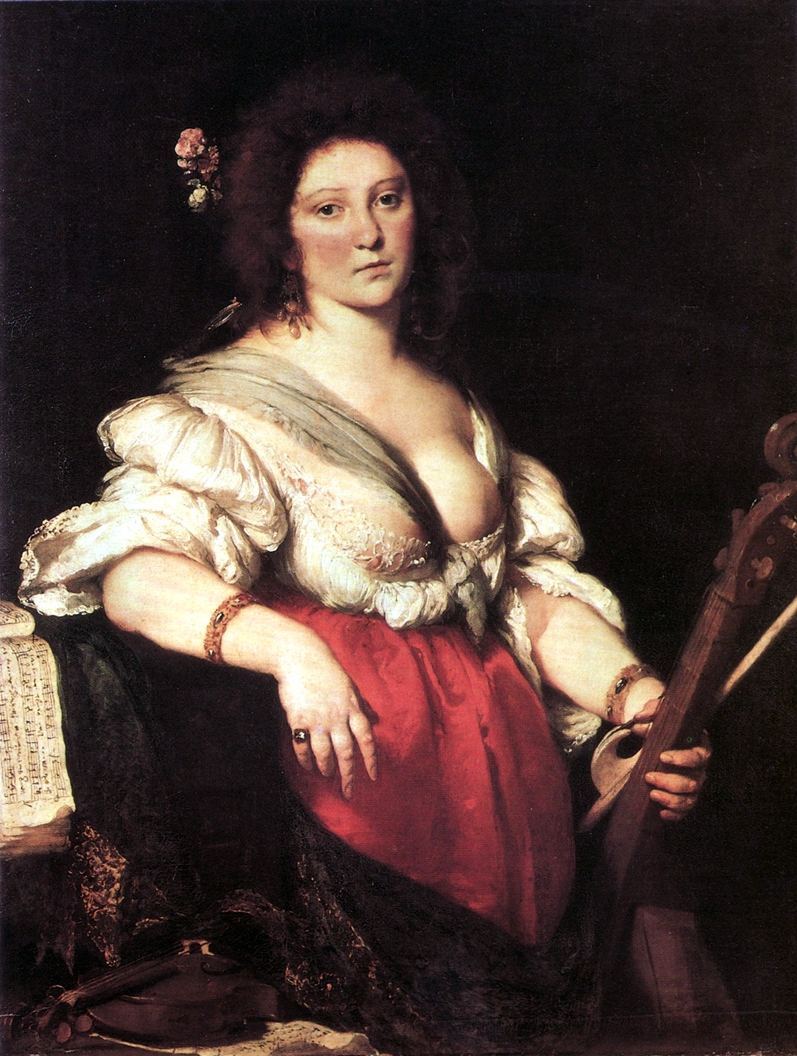
Then Strozzi painted the image of "Woman with a Viola da Gamba." 

The painting has some of the elements that match it to a St. Cecilia: the musical instrument, the pose of a young woman visible to the waist. But there all resemblance to a picture of saint ends. This young woman is not transported, she looks at the viewer directly, with a worldly and somewhat bored gaze. She is not modest at all; in fact, her cleavage is so low that one breast is completely bared. 

The bared breast and the fact that there is a violin in the image, along with her viola da gamba, and the music is for a duet suggests that she is waiting for a partner to come and "make music" with her. In other words, that she is a courtesan. 

I referred to this image in The Saffron Crocus, and the heroine's discovery of it marks a key turning point in her understanding of the world. At the time I wrote the book I accepted the traditional interpretation of the painting, that the pose and the décolletage indicated that the sitter was a courtesan. Since then I've learned a few things which are much more interesting than the traditional interpretation.

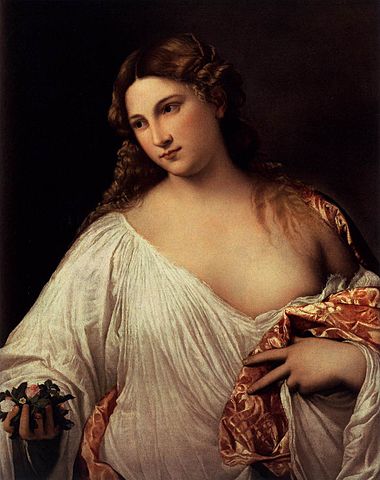
For example, some have argued that the portrait is an allegorical image, of Flora, similar to Titian's:


Courtesans in Venice did bare their breasts, as a way of marketing their goods, and tinted their nipples red. Or they stood on their roofs, bleaching their hair to achieve a blond color, wearing nothing but a shimmery shift that also revealed their breasts to any passerby. 

But it's hard to say that the bare breast in this image indicates the woman is a courtesan. Strozzi used bare-breasted women in many images, usually allegorical ones, such as his allegory of the arts:


Scholars David Rosand and Ellen Rosand have argued that the picture of the viola da gamba player picture is actually a portrait of Barbara Strozzi (no relation to Bernardo). They have various reasons for this attribution, mainly, that events we know about her life match the depiction in the image. Specifically, they refer to the fact that Barbara Strozzi was the "mistress of ceremonies" of the Accademia degli Unisoni, a salon for philosophical and artistic discussion organized by her adoptive (her perhaps natural) father, Giulio Strozzi. The Rosands mention a particular event that might have led to the pose and costume in the portrait in which Barbara sang and handed out flowers as prizes to the one who wrote the most impressive argument on whether tears or song was the most potent weapon in love. 

As I read about this attribution I became eager to know more about Barbara Strozzi. Not whether she was a courtesan (there is evidence that she partnered with one man most of her life, as she had three children with him) but as a musician. 

She wasn't the first musician to have her music published. That honor goes to Maddalena Cassulana whose first work, a collection of four madrigals, was published in Florence in 1566. But Strozzi published voluminously, more than any other composer of her time. She is credited with creating the cantata. And she did all this without the patronage of a noble or the church. She spent her life trying to find such patronage and did not succeed. 

She did have her father's support, though. At least one scholar claims Giulio Strozzi created the Accademia degli Unisoni to encourage her work. Though her association with the Unisoni is also what led to outsiders claiming she had sold her virtue. 

It seems sad to me that what most people might know about Strozzi is these allegations that she was a courtesan. That bared breast is all we see when we look at that image. I encourage my readers to listen to her music instead. Here's a lovely performance of her aria "Che si può fare":


About the book
Publication Date: December 13, 2014
Black Opal Books
eBook; 306p
Genre: Young Adult/Historical Mystery/Romance

Add to GR Button

Winner of the 2014 Rosemary Award for Best Historical for Young Adults.
Venice, 1643. Isabella, fifteen, longs to sing in Monteverdi’s Choir, but only boys (and castrati) can do that. Her singing teacher, Margherita, introduces her to a new wonder: opera! Then Isabella finds Margherita murdered. Now people keep trying to kill Margherita’s handsome rogue of a son, Rafaele.

Was Margherita killed so someone could steal her saffron business? Or was it a disgruntled lover, as Margherita—unbeknownst to Isabella—was one of Venice’s wealthiest courtesans?

Or will Isabella and Rafaele find the answer deep in Margherita’s past, buried in the Jewish Ghetto?

Isabella has to solve the mystery of the Saffron Crocus before Rafaele hangs for a murder he didn’t commit, though she fears the truth will drive her and the man she loves irrevocably apart.

Excerpt

Who knew a singing career would be this much trouble?

“Rafaele!” She flew into the garret. “Piero, it was so wonderful, wait until I tell you!”

The stool next to the bed was knocked over. The tray with the genepy bottle was on the floor, one of the cups broken. The fat candle that had been burning next to Rafaele’s bed had been flung to the other side of the room.. Canvases were strewn all over the floor, some of them slashed, and many of Master Strozzi’s jars of paint elements were broken.

Did Piero and Rafaele have a fight? She quickly suppressed the thought. Who would get into a fight with a man who was already injured?

Something else must have happened.

She walked across the garret. “Piero? Rafaele, are you here?”

Rafaele was not in the bed. The sheets and blankets she had piled on top of him were strewn everywher. Blood-stained sheets spilled over the edge of the pallet. There was a pile of clothes on the floor.

She walked around to get a closer look.

Not clothes. It was Piero. Face down, one arm stretched out before him, as if in supplication.

A puddle of blood under him.

Dead.

Praise for The Saffron Crocus
“I adored this beautifully written, passionate book. The Saffron Crocus is a glittering, thrilling opera of a novel that plucked my heartstrings and kept me reading at fever pitch. Brava, Alison McMahan! Encore!” -Nancy Holder, New York Times Bestselling Author of the Wicked Saga

Buy the eBook


About the Author
Alison McMahan chased footage for her documentaries through jungles in Honduras and Cambodia, favelas in Brazil and racetracks in the U.S. She brings the same sense of adventure to her award-winning books of historical mystery and romantic adventure for teens and adults. Her latest publication is The Saffron Crocus, a historical mystery for young. Murder, Mystery & Music in 17th Century Venice.

She loves hearing from readers!

Author Links


Tour Schedule: http://hfvirtualbooktours.com/thesaffroncrocusblogtourandbookblast/
Hashtags: #TheSaffronCrocusBookBlast #TheSaffronCrocusBlogTour #YA #Historical #Venice
Twitter Tags: @hfvbt @AlisonMcMahan

Giveaway
Enter to win a paperback copy of The Saffron Crocus, open to US residents only.

Rules
– Must be 18 or older to enter.
– Giveaway is open to US residents only..
– Only one entry per household.
– All giveaway entrants agree to be honest and not cheat the systems; any suspect of fraud is decided upon by blog/site owner and the sponsor, and entrants may be disqualified at our discretion.


The Saffron Crocus Giveaway

April 23, 2015

Spotlight on David Morrell's Inspector of the Dead with Guest Post by Robert Morrison


Thomas De Quincey and the Afflictions of Childhood

Action and brilliant twists of plot are at the crux of David Morrell’s two historical thrillers, Murder as a Fine Art and Inspector of the Dead, both of which are set in 1850s London, and both of which feature assassins whose killing sprees are as ingenious as they are ruthless. What sets the two novels decisively apart from other Victorian murder mysteries, though, is the fictionalized presence of Thomas De Quincey (1785-1859), the notorious English author and opium addict.


Morrell seamlessly weaves details from De Quincey’s writings into the fabric of both novels, but he also exploits in full the circumstances of De Quincey’s remarkable life, as indeed De Quincey himself did in some of his finest essays. Born into prosperity, De Quincey exhausted his patrimony by the time he was 30 (primarily because he could not stop buying books), and spent much of the next forty years harried by debt and debt collectors. He read widely as a boy, and acquired a reputation as a brilliant classicist, especially in Greek. At 17 De Quincey bolted from Manchester Grammar School, and spent four harrowing months penniless and hungry on the streets of London. He entered Oxford University in 1803, but left five years later without taking his degree and moved to the English Lake District to be near his two literary idols, William Wordsworth and Samuel Taylor Coleridge. In 1813 De Quincey became dependent on opium, a drug he started experimenting with during his student days at Oxford, and over the next few years he sank deeper into debt and addiction, before launching himself as a professional writer.

It is, however, the close ties of his family life that most clearly fascinate Morrell. Death cast a terrible blight on De Quincey as a very young boy, and in many ways he never fully recovered. Before he was 8 he had lost his sister Jane, his father, and then another sister, Elizabeth, who was his dearest childhood friend, and whose sudden passing never ceased to haunt him. His portrait of Ann of Oxford Street, the young London prostitute he met as a teenage runaway, and his overwhelming sorrow at the death in 1812 of Wordsworth’s three-year-old daughter Catherine, are clearly shaped by his grief over Elizabeth’s death, as is Suspiria de Profundis (“Sighs from the Depths”), De Quincey’s great 1845 sequel to his Confessions.


In Murder as a Fine Art, Morrell memorably conjures the anguish of these losses in the scene where De Quincey enters Vauxhaul Gardens, and sickly prostitutes hired by the killer call out to him with names that bring his deepest griefs surging back to the surface: “I’m Ann!” one of the women yells. “No, I’m Ann!” cries another. “I’m Jane!” bawls a third. Then more voices and other deaths: “Elizabeth!” “Catherine!” “Love us, Thomas!” De Quincey sinks to his knees, unable to endure the memory of so much sorrow, and horrified to think that the assassin knows so well how to wound him.

Morrell is equally interested in De Quincey as a father. In 1806, as he wandered through the Lake District, the 21-year-old De Quincey made a manuscript list of twelve “Constituents of Happiness,” one of which was the “education of a child.” But by 1816, when he became a father for the first time, his life was already spiralling out of control, and in the years that followed he was often unable to provide for his wife Margaret and a family that grew ultimately to eight children. Perhaps most devastatingly, in 1834, as his teenage son William lay writhing in the grip of leukaemia, De Quincey listened as his son told the doctor of his physical pain, but also of his mental anguish, for the boy’s mind was full of “family distresses” – the fear, and penury, and despair that had surrounded him for his entire life. When William died, De Quincey’s grief – and guilt – were intense.

De Quincey’s youngest daughter Emily was twenty-one months old at William’s death, and while she never really knew him, she grew up like him in chaos – running from bill collectors, sneaking through back streets to deliver her father’s manuscripts to publishers, and watching helplessly as his drug addiction drove him down to rock-bottom. Yet by the 1840s the family’s finances had started to stabilize, thanks to the caution and courage of Emily and her two older sisters Margaret and Florence, all three of whom were devoted to De Quincey, but acutely aware of his failings. “I think no one will make much out of my father who does not take in the extreme mixture of childish folly joined to a great intellect,” Emily once declared.


In Inspector of the Dead, De Quincey’s relationship with Emily is center stage, and Morrell crafts marvellous exchanges between the two, as he plumbs the workings of their relationship, and demonstrates the ways in which Emily has been both constrained and liberated by her father. Yet perhaps the most moving moment in the novel comes when the two discuss – not the present or the future – but the traumas of the past, and De Quincey confesses his guilt. “In many ways, you are the parent, and I am the child,” he tells Emily. “I only wish that I had watched over you with as much devotion. I’m deeply sorry.” In such moments, Morrell brings De Quincey vividly before us, as a man who moved many to deep affection, despite courting the disasters that so often overtook him.

Morrell’s masterful handing of characterization and pace – his ability to combine heart-pounding action with forceful moments of pathos and emotional insight – are what distinguish both Murder and Inspector. De Quincey’s writings on drugs and violence are key to the process, but no less important are those incidents from his private life that both shattered and inspired him.

About the book
Publication Date: March 24, 2015
Mulholland Books
Hardcover; 342p
ISBN: 9780316323932
Genre: Historical Mystery

Add to GR Button

David Morrell’s MURDER AS A FINE ART was a publishing event. Acclaimed by critics, it made readers feel that they were actually on the fogbound streets of Victorian London. Now the harrowing journey continues in INSPECTOR OF THE DEAD.

Thomas De Quincey, infamous for his Confessions of an Opium-Eater,confronts London’s harrowing streets to thwart the assassination of Queen Victoria.

The year is 1855. The Crimean War is raging. The incompetence of British commanders causes the fall of the English government. The Empire teeters.

Amid this crisis comes opium-eater Thomas De Quincey, one of the most notorious and brilliant personalities of Victorian England. Along with his irrepressible daughter, Emily, and their Scotland Yard companions, Ryan and Becker, De Quincey finds himself confronted by an adversary who threatens the heart of the nation.

This killer targets members of the upper echelons of British society, leaving with each corpse the name of someone who previously attempted to kill Queen Victoria. The evidence indicates that the ultimate victim will be Victoria herself. As De Quincey and Emily race to protect the queen, they uncover long-buried secrets and the heartbreaking past of a man whose lust for revenge has destroyed his soul.

Brilliantly merging historical fact with fiction, Inspector of the Dead is based on actual attempts to assassinate Queen Victoria.

Praise for Inspector of the Dead
“Riveting! I literally thought I was in 1855 London. With this mesmerizing series, David Morrell doesn’t just delve into the world of Victorian England—he delves into the heart of evil, pitting one man’s opium-skewed brilliance against a society where appearances are everything, and the most vicious killers lurk closer than anyone thinks.” —Lisa Gardner, New York Times bestselling author of Crash & Burn and The Perfect Husband

What the Victorian Experts Say:

“Even better than Murder as a Fine Art. A truly atmospheric and dynamic thriller. I was fascinated by how Morrell seamlessly blended elements from Thomas De Quincey’s life and work. The solution is a complete surprise.” —Grevel Lindop, The Opium-Eater: A Life of Thomas De Quincey

“The scope is remarkable. Florence Nightingale, the Crimean War, regicide, the railways, opium, the violence and despair of the London rookeries, medical and scientific innovations, arsenic in the food and clothing—all this makes the Victorian world vivid. The way Morrell depicts Thomas De Quincey places him in front of us, living and breathing. But his daughter Emily is in many ways the real star of the book.” —Robert Morrison, The English Opium-Eater: A Biography of Thomas De Quincey

“I absolutely raced through it and couldn’t bear to put it down. I particularly liked how the very horrible crimes are contrasted with the developing, fascinating relationship between Thomas De Quincey and his daughter, Emily, who come across as extremely real. It was altogether a pleasure.” —Judith Flanders, The Invention of Murder: How the Victorians Reveled in Death and Detection and Created Modern Crime


About the Author
David Morrell is an Edgar, Nero, Anthony, and Macavity nominee as well as a recipient of the prestigious career-achievement Thriller Master away from the International Thriller Writers. His numerous New York Times bestsellers include the classic espionage novel. The Brotherhood of the Rose, the basis for the only television mini-series to be broadcast after a Super Bowl. A former literature professor at the University of Iowa, Morrell has a PhD from Pennsylvania State University. His latest novel is INSPECTOR OF THE DEAD, a sequel to his highly acclaimed Victorian mystery/thriller, Murder as a Fine Art, which Publishers Weekly called ”one of the top ten mystery/thrillers of 2013.”

For more information visit David Morrell’s website. You can also connect with him on Facebook and Twitter.


Visit the Tour Schedule
Hashtags: #InspectoroftheDeadBlogTour #HistoricalMystery
Twitter Tags: @hfvbt @_DavidMorrell

March 23, 2015

Spotlight on Colin Falconer's The School of Night


Publication Date: October 7, 2014
Cool Gus Publishing
Formats: eBook, Paperback
Pages: 168
Series: The William Shakespeare Detective Agency
Genre: Historical Mystery

Add to GR Button

“My name is William Shakespeare. No, not that Shakespeare; and no jests please, I’ve heard them all. I’m the other one, the ne’er do well cousin, the loafer, known to family and friends as the dunce, the one who could not recite Cicero or Horace, who could never be as good as his clever cuz, the one who has just come to Bishopsgate from Stratford with silly dreams in his head and a longing to make something more of himself than just a glover’s handyman.”

What he finds in London is Lady Elizabeth Talbot, who is willing to pass a few shillings to this blundering brawler if he will help her find her husband. Poor William does not realize the trail will lead to the truth behind the death of Shakespeare’s great rival, Christopher Marlowe – or to a lifelong love affair with a woman far above his station.

Each book tells the story of William’s adventures as England’s first gumshoe, set against turbulent Elizabethan politics; of his romantic pursuit of the impossible Elizabeth Talbot; while charting the career of his up and coming dramatist cousin, the bard of Stratford, but just Will to his family.

Buy the Book


About the Author
Born in London, Colin first trialed as a professional football player in England, and was eventually brought to Australia. He went to Sydney and worked in TV and radio and freelanced for many of Australia’s leading newspapers and magazines. He has published over twenty novels and his work has so far been translated into 23 languages.

He travels regularly to research his novels and his quest for authenticity has led him to run with the bulls in Pamplona, pursue tornadoes across Oklahoma and black witches across Mexico, go cage shark diving in South Africa and get tear gassed in a riot in La Paz.

He currently lives in Barcelona.

For more information please visit Colin Falconer’s website. You can also find him on Facebook or follow on Twitter.


Visit other blogs on the tour--Tour Schedule
Twitter Hashtag: #SchoolofNightBlogTour #HistoricalMystery #Historical
Twitter Tags: @hfvbt @colin_falconer

February 06, 2015

Tessa Arlen's Death of a Dishonorable Gentleman - Guest Post and {Giveaway}


Why does the Britain of the early 1900s intrigue and delight so many of us?

Today the great houses of Britain’s landed aristocracy with their vast, exquisite interiors and views of sweeping parkland attest to the power of rank and wealth of a bygone age. They also provide a stunning backdrop for elegantly clothed men and women with gracious manners who star in numerous costume dramas acquired for Masterpiece Theatre from the mother-lode of British television. We are presently enraptured by the first two decades of the 1900s.


Imagine you have been invited for a Saturday-to-Monday, as the Edwardians called a weekend, to one of their glorious country houses. Here is a little advice to bear in mind for your short stay, after all you might want to be invited back!


Whatever you do don’t alienate the servants: It is important not to underestimate how the Edwardians related to those who ensured their comfort and provided them with flawless and devoted service. Servants employed in the great houses were part of the family, but not of it; a sizeable distinction because it relies on generations of subtle understanding of the polite, but offhand tact, used by the uppers when they addressed the lower orders. Butlers, footmen and personal maids will be extraordinarily unforgiving if you wear incorrect attire for the country, and cruelly punishing if you are either patronizingly familiar or arrogantly dismissive. So beware! The butler and the housekeeper will be far more intimidating than the charmingly eccentric dowager duchess or that affable old colonel you will be seated next to when you arrive in time for tea.


Your Edwardian great-grandmother would have been able to give you some good advice. Huge pointers for your comportment this weekend would be restraint, restraint, and more restraint in a way we can’t begin to imagine today. Your great-grandmother would be the first to remind you to lower your voice to a well-modulated murmur, that it is rude to interrupt, or even be too enthusiastic. Do not comment on your surroundings, the magnificence of the house, or marvel at the deliciousness of your dinner. You are not on a ‘girls’ night out’, no matter how confiding and wickedly risqué your new Edwardian girlfriends appear to be, or how many glasses of wine the footman pours for you at dinner. So sorry I meant to say self-restraint – just place your hand palm down over your wine glass to indicate no thank you, when you feel a delighted shriek start to emerge.


This was a time when women were treated like goddesses . . . then they married and were kept at home to incubate an heir and a spare. While the men at your country house weekend enjoy shooting and fishing, you encouraged to watch and applaud, but not join to in. When they sit back to their port and a cigar after dinner your hostess will beckon you away with the other women – important that you go with them. Despite the luxurious existence of the early 1900s, most women today would find it impossible to live the hidebound, restricted life of early 20th century women. So after you have lugged in the groceries after a hard day at the office, made dinner and then helped the kids with their homework before putting them to bed, just in time to collapse on the sofa to catch an episode of Downton, try not to sigh too deeply when Mathew Crawley goes down on one knee in the swirling snow to propose to Lady Mary. Most of us would have been Ivy slogging away in the scullery and not Lady Grantham reading a novel in the drawing room!


Did the Edwardian Shangri-La portrayed in Downton Abbey really exist at all even for the upper classes? The short answer is ‘Yes’ if you were Lord Grantham and not his valet. If you have a problem not seeking to right the inequities of life, then don’t get on that train at London’s Marylebone station for the country. Certainly there were drunken, abusive husbands, negligent and thoughtless parents, spendthrifts and philanderers in the Edwardian age . . . and wronged wives looked the other way. The trick to coping with the darker side of human nature, if you were of society, was that it must never be referred to, never confided and most definitely never publicly acknowledged. However if you are an egalitarian at heart and social ostracism doesn’t bother you too much, you might join Mrs. Pankhurst’s suffragettes and militantly proclaim your opinions. I have heard that Holloway Prison was equipped with a special wing for militant members of the WSPU!


The third housemaid will unpack your trunk for you – five changes of clothes a day for three days need an awful lot of tissue paper. Here’s a titillating scrap of fresh society gossip to share with the company – gossip was the spice of Edwardian life. Gladys, the Marchioness of Ripon, an ultra-sophisticate with a ‘past’ was a wonderful example of the Edwardian double-standard and loved to gossip with her close coterie of friends. Alone in her lover’s house one day she discovered a pile of rivetingly indiscrete love letters written to him by one of her social adversaries, Lady Londonderry. Gladys swiped the lot and generously shared the juicy bits – read aloud after dinner – with her closest friends. After the fun was over she honorably returned the letters to their author at Londonderry House ─ when she knew husband and wife were dining alone. The butler approached his Lordship and handed over the ribbon-bound bundle. After studying the contents, in silence, Lord Londonderry directed him to carry the letters to the other end of the dining table. Silence still reigned as Lady Londonderry came to terms with her awful predicament, a silence that was never broken between the two of them again. Far worse than having an affair, Lady Londonderry had ‘Let down the side.’ Adultery was a fact of life, indiscretion unforgiveable; to be the subject of common gossip shameful and the scandal of divorce out of the question. Lord Londonderry never spoke to his wife in private again, and maintained a distant, cold courtesy to her in public for the rest of their long marriage - so much more entertaining than a splashy tabloid divorce!

I couldn’t resist writing a mystery of betrayal, blackmail and revenge set in 1900s England because of this wonderful double-standard in Edwardian England. There is nothing more delicious than putting a group of privileged elitists on the spot at a country house Saturday-to-Monday by subjecting them to a police enquiry as to where they were, and who they were with, at the time of death.

About the book
Publication Date: January 6, 2015
Minotaur Books
Formats: eBook, Hardcover
Genre: Historical Mystery

Add to GR Button

Lady Montfort has been planning her annual summer costume ball for months, and with scrupulous care. Pulling together the food, flowers and a thousand other details for one of the most significant social occasions of the year is her happily accepted responsibility. But when her husband’s degenerate nephew is found murdered, it’s more than the ball that is ruined. In fact, Lady Montfort fears that the official police enquiry, driven by petty snobbery and class prejudice, is pointing towards her son as a potential suspect.

Taking matters into her own hands, the rather over-imaginative countess enlists the help of her pragmatic housekeeper, Mrs. Jackson, to investigate the case, track down the women that vanished the night of the murder, and clear her son’s name. As the two women search for a runaway housemaid and a headstrong young woman, they unearth the hidden lives of Lady Montfort’s close friends, servants and family and discover the identity of a murderer hiding in plain sight.

In this enchanting debut sure to appeal to fans of Downton Abbey, Tessa Arlen draws readers into a world exclusively enjoyed by the rich, privileged classes and suffered by the men and women who serve them. Death of a Dishonorable Gentleman is an elegant mystery filled with intriguing characters and fascinating descriptions of Edwardian life—a superb treat for those who love British novels.

A Party for Winston, the second book in the series to be released in January 2016.

Praise for Death of a Dishonorable Gentleman
“Tessa Arlen has a worthy debut with Death of a Dishonorable Gentleman. With a deliciously gruesome murder and an unlikely pair of sleuths, this is a treat for fans of Downton Abbey who will want to devour it with a nice steaming pot of Earl Grey.” —New York Times bestselling author Deanna Raybourn

“In her debut novel, Tessa Arlen weaves an evocative tale of the passions, loyalties and ambitions that divide and unite two classes, upstairs and downstairs, in a stately home. She instantly transports the reader to Edwardian England.”—Christine Trent, author of Stolen Remains

“A dash of noblesse oblige sparkles between the upstairs/downstairs world of Lady Montfort and her housekeeper, Mrs. Jackson, as they work together to unmask the identity of a killer at large on the Montfort’s country estate. As sharp as a Nancy Mitford novel, Tessa Arlen’s sophisticated Death of a Dishonorable Gentleman deserves its place among the Great and the Good of classic mystery.”—Lyndsy Spence, founder of The Mitford Society and author of The Mitford Girls’ Guide to Life.

“Thoroughly enchanting. Arlen’s debut will appeal to fans of Downton Abbey, with its vivid descriptions, firm grip on the intricacies of the time period, and skilled portrayal of the often complicated relationship between upstairs and downstairs.” —Anna Lee Huber, author of the Lady Darby mystery series

Buy the Book


About the Author
TESSA ARLEN, the daughter of a British diplomat, had lived in or visited her parents in Singapore, Cairo, Berlin, the Persian Gulf, Beijing, Delhi and Warsaw by the time she was sixteen. She came to the U.S. in 1980 and worked as an H.R. recruiter for the Los Angeles Olympic Organizing Committee for the 1984 Olympic Games, where she interviewed her future husband for a job. DEATH OF A DISHONORABLE GENTLEMAN is Tessa’s first novel. She lives in Bainbridge Island, Washington.

For more information please visit Tessa Arlen’s website. Read Tessa Arlen’s blog at Redoubtable Edwardians. You can also connect with her on Facebook, Twitter, and Goodreads.

Subscribe to Tessa Arlen’s Newsletter.

Read my review of this fabulous book here.


Visit other blogs on the tour--Tour Schedule
Twitter Hashtag: #DishonorableGentlemanBlogTour #HistoricalMystery #HistFic
Twitter Tags: @hfvbt @MinotaurBooks @TessaArlen


Follow the instructions on the Gleam form below to enter for a chance to win a paperback copy of Death of a Dishonorable Gentleman by Tessa Arlen! (Open to U.S. only)


Death of a Dishonorable Gentleman